
Dynamic employee scheduling has changed how organizations manage hourly and frontline workforces. But with greater flexibility comes greater complexity. And employee scheduling compliance has quickly become one of the biggest operational challenges organizations face today. Dynamic employee scheduling gives organizations more flexibility to manage hourly and frontline workers, but it also introduces more risk. The moment schedules start shifting in real time, compliance gets harder to manage, and small mistakes can snowball fast.
If you manage an hourly workforce, you already know scheduling isn’t just about filling shifts anymore. Across frontline-heavy commercial industries and for fast-moving environments like retail, healthcare, and hospitality, employee scheduling requires navigating a growing web of labor laws, union rules, internal policies, and employee expectations, all without slowing down the business.
That’s where compliance moves from being a “nice-to-have” to a critical part of workforce management.
The reality: scheduling has gotten complicated
Modern scheduling is dynamic by necessity. Demand fluctuates. Employees swap shifts (or callout completely). Managers need to quickly backfill coverage gaps. Last-minute changes are a given.
On top of that, you’re dealing with a growing list of compliance requirements, and missing one can have real consequences
- Predictive scheduling laws (fair workweek regulations)
- Overtime and rest break requirements
- Minor labor restrictions
- Union agreements and contract rules
- Role-based certifications and qualifications
- Multi-location labor law differences
Making sure you’re adhering to these regulations across your workforce adds friction and risk to everyday scheduling decisions, fundamentally shifting scheduling from a tactical task into a compliance-driven process.
Without clear guardrails, even a simple shift change can turn into a compliance issue. Legislation is expanding across states and municipalities, while employees are demanding more transparency, fairness, and predictability in their schedules. The result: compliance is no longer static; It’s dynamic, just like scheduling itself.
The cost of getting it wrong
Many organizations underestimate how quickly small scheduling decisions can create compliance risk and exposure.
Compliance failures don’t start and end with HR — they’re shared responsibility that impacts the entire business.
- A last-minute shift swap that violates predictive scheduling laws
- An overlooked overtime threshold
- Scheduling an employee without the right certification
Individually, these seem minor. Collectively, they create significant risk:
- Financial penalties from labor law violations
- Increased labor costs due to unplanned overtime
- Operational inefficiency from manual manager checks and rework
- Employee dissatisfaction and low engagement when rules feel inconsistent or unfair
- Reputational risk in highly regulated or public-facing industries
And the biggest challenge? Most of these issues aren’t intentional. They happen because manual processes can’t keep up with complex rules.
Why static systems fall short
Spreadsheets and basic scheduling tools weren’t built for this level of complexity. They rely heavily on manual oversight. And even many modern workforce management solutions struggle to keep up in highly dynamic environments.
Managers are expected to interpret rules, apply them consistently, and catch potential issues before they become real problems. In many systems, compliance is still treated as a static set of rules, configured once and expected to hold up in constantly changing scheduling conditions. But in reality, schedules shift daily, and compliance risks shift with them.
This model breaks in dynamic environments where organizations rely on managers to:
- Remember rules across multiple locations with different regulations
- Apply them consistently when schedule changes are frequent
- Catch conflicts before they happen
That’s not scalable and it’s not realistic in fast-moving, high-volume environments. When scheduling is dynamic, but compliance tools are not, gaps start to appear. The result: missed violations, reactive fixes, and increased risk.
Compliance can’t depend on memory or manual checks. It needs to be built into the system, not layered on top of it. The challenge isn’t just managing compliance, it’s managing compliance in motion.
From reactive to proactive: a better approach with Humanity Schedule
The shift is simple: stop reacting to compliance issues after they happen. Build compliance directly into your scheduling process from the start. That’s easier said than done when schedules change daily, but it’s exactly what solutions like Humanity Schedule are designed to handle.
Instead of relying on managers to remember rules or double-check every decision, you can build those guardrails directly into how schedules are created and updated.
With Humanity Schedule, that looks like:
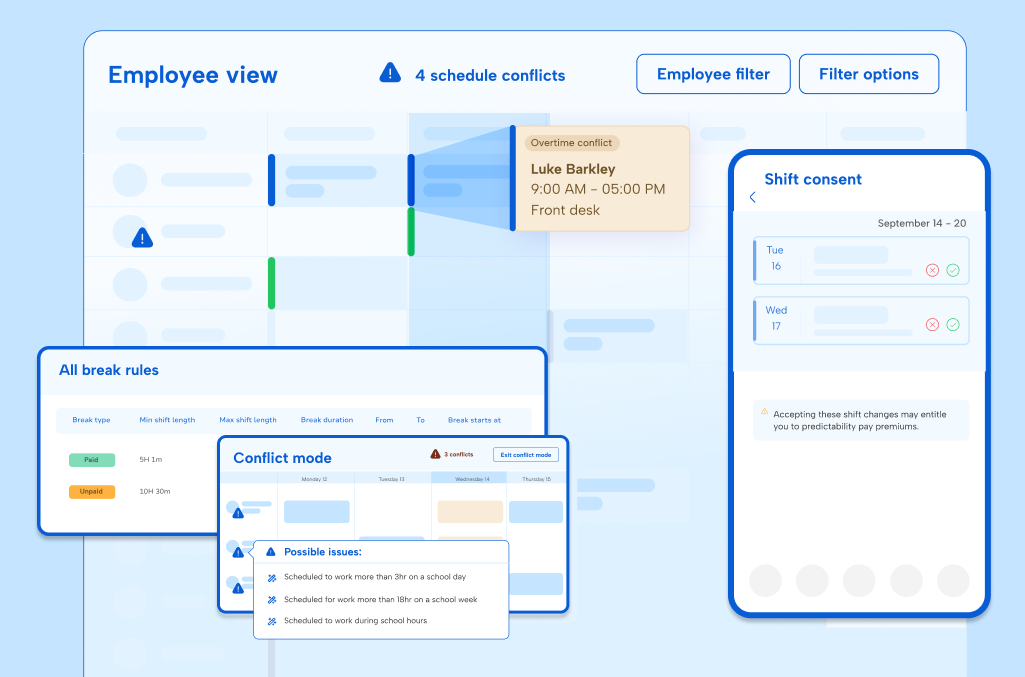
- Automated compliance checks that flag or prevent violations before schedules are published
- Rule-based scheduling aligned to labor laws, union agreements, and company policies
- Location-aware configurations that automatically apply jurisdiction-specific rules based on where employees work
- Qualification and certification tracking to ensure the right, properly credentialed employees are scheduled for specific tasks or shifts
- Audit-ready reporting for a clear, defensible record of scheduling decisions
Instead of catching mistakes after the fact, you’re preventing them as schedules are built. That reduces risk, cuts down on rework, and gives managers more confidence in every decision they make.
Most importantly, it makes compliance scalable. As your workforce grows, your scheduling process doesn’t get harder to manage, it gets more consistent.
Compliance as a competitive advantage
Organizations that get compliance management right aren’t just reducing risk, they’re gaining an edge. Yes, compliance is a requirement, but it’s also a strategic lever for operational excellence.
Here’s where the conversation is evolving:
Leading organizations are no longer asking, “How do we avoid compliance issues?”
They’re asking, “How can compliance improve how we operate?”
When done right, compliance enables:
- More consistent and fair scheduling practices
- Faster decision-making with less risk
- Reduced administrative overhead for managers
- Stronger employee trust and retention
- Better alignment between operations, HR, and legal teams
In short, compliance becomes a foundational driver for scalability and operational resilience, not just a checkbox for risk mitigation. It’s about building a scheduling process you can trust — one that supports your team, keeps you aligned with regulations, and holds up even as conditions change.
As scheduling gets more complex, that foundation isn’t optional. It’s what allows your organization to scale, adapt, and operate with confidence.
TCP Software’s employee scheduling, time, and attendance solutions are flexible and scalable to accommodate your organization and employees as you grow.
From TimeClock Plus, which automates even the most complex payroll calculations and leave management requests, to Humanity Schedule for dynamic employee scheduling that saves you time and money, we have everything you need to meet your organization’s needs, no matter how unique.
Plus, with Aladtec, we offer 24/7 public safety scheduling solutions for your hometown heroes.
Ready to learn how TCP Software takes the pain out of employee scheduling and time tracking? Speak with an expert today.
What to read next
Explore all resources





 Link copied!


