
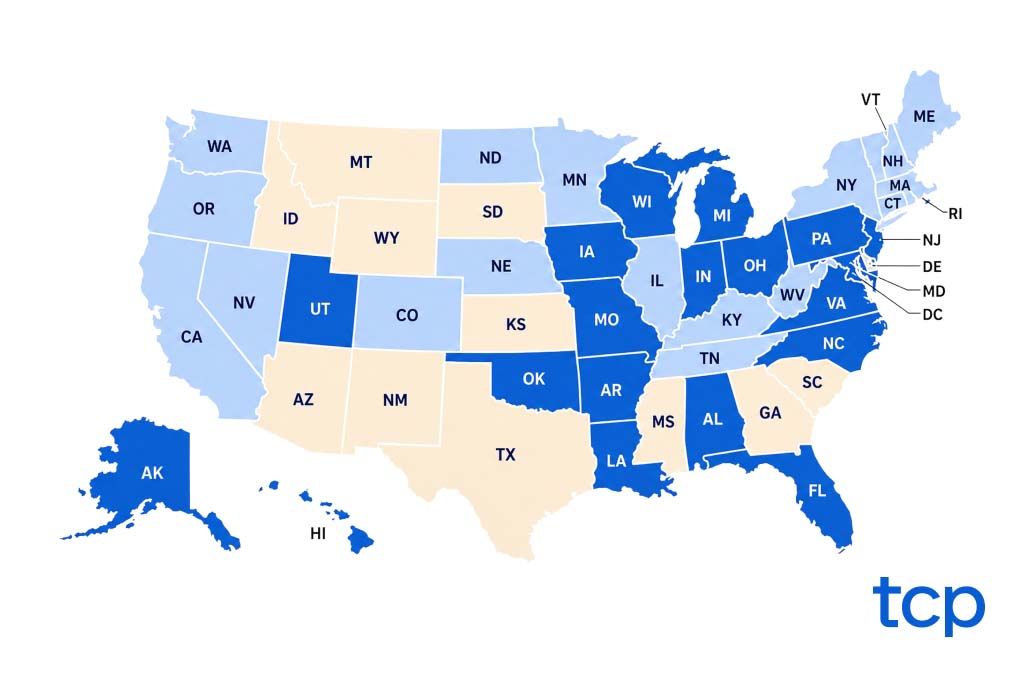
State labor compliance. It never sits still, and it rarely looks exactly the same across state borders.
Breaks, overtime, employee leave, minimum wage, and more all shift by your state (sometimes location within the state), industry, and employee count. One missed detail can mean back pay, a compliance complaint, or a costly correction cycle.
This guide walks through each state’s requirements so you can build scheduling, time tracking, and leave management practices with confidence.
How the state labor compliance guide is organized
Each state section is organized into five parts so you can jump straight to what you need (breaks, overtime, employee leave, minimum wage, and minor labor laws), and each requirement is cited to the current statute or agency source behind it.
Use the navigation headers or jump links below to find your state. The dropdown menus show you the labor compliance overview for your state.
Alabama | Alaska | Arizona | Arkansas | California | Colorado | Connecticut | Delaware | District of Columbia (D.C.) | Florida | Georgia | Hawaii | Idaho | Illinois | Indiana | Iowa | Kansas | Kentucky | Louisiana | Maine | Maryland | Massachusetts | Michigan | Minnesota | Mississippi | Missouri | Montana | Nebraska | Nevada | New Hampshire | New Jersey | New Mexico | New York | North Carolina | North Dakota | Ohio | Oklahoma | Oregon | Pennsylvania | Rhode Island | South Carolina | South Dakota | Tennessee | Texas | Utah | Vermont | Virginia | Washington | West Virginia | Wisconsin | Wyoming
Alabama
Alabama labor compliance chart
| Alabama break laws | Alabama doesn’t mandate meal or rest breaks for adult employees. When an organization offers breaks anyway, the federal baseline kicks in: short breaks stay paid, and any unpaid meal period of 30 minutes or more requires the employee to be completely off duty. | (Source: U.S. Department of Labor, state labor law topics; Alabama Department of Labor.) |
| Alabama overtime laws | Alabama defers entirely to the federal FLSA on overtime: 1.5 times the regular rate after 40 hours in a workweek, with no separate daily trigger written into state law. | (Source: 29 U.S.C. § 207; Alabama Department of Labor.) |
| Alabama employee leave laws | Alabama has no state law requiring paid sick leave, paid family leave, or paid vacation. Federal FMLA still applies to eligible employees at organizations with 50 or more employees, providing up to 12 weeks of unpaid, job-protected leave. | (Source: Alabama Department of Labor; 29 U.S.C. § 2601 et seq.) |
| Alabama minimum wage laws | Alabama has no state minimum wage law at all, so the federal minimum wage of $7.25 an hour applies by default. A 2016 state law also blocks cities and counties from setting a higher local minimum. | (Source: U.S. Department of Labor, state minimum wage laws; Alabama Uniform Minimum Wage and Right-to-Work Act, 2016.) |
| Alabama minor labor laws | Alabama follows the federal hour limits for minors under 16 and caps the workweek at 6 days. Enrolled students up to age 19 also can’t work from 10 p.m. before a school day to 5 a.m., though exemptions are possible for 16- and 17-year-olds when they serve the minor’s best interest. | (Source: U.S. Department of Labor, Selected State Child Labor Standards; Alabama Department of Labor.) |
What this means for your organization: With nothing layered on top at the state level, every wage and hour question in Alabama runs straight through federal FLSA recordkeeping requirements. That makes accurate time records more important here, not less, since there’s no state-level buffer if a punch is missed or an employee is misclassified.
Alaska
Alaska labor compliance chart
| Alaska break laws | No Alaska statute requires meal or rest breaks for adult workers. Organizations that provide breaks voluntarily still follow federal rules: short breaks count as paid time, and a 30-minute-or-longer unpaid meal period only qualifies if the employee is fully relieved of duty. | (Source: U.S. Department of Labor, state labor law topics; Alaska Department of Labor and Workforce Development.) |
| Alaska overtime laws | Alaska requires overtime pay after 8 hours in a single day and after 40 hours in a week, with both thresholds applying independently at 1.5 times the regular rate. A nine-hour shift earns an hour of overtime even if the employee’s total for the week stays under 40. | (Source: Alaska Stat. § 23.10.060.) |
| Alaska employee leave laws | A new paid sick leave law took effect July 1, 2025. Employees earn 1 hour of paid sick leave for every 30 hours worked: up to 56 hours a year at organizations with more than 15 employees, or 40 hours a year at smaller ones. No doctor’s note is required to use it. | (Source: Alaska Stat. § 23.10.066, enacted via Ballot Measure 1, 2024.) |
| Alaska minimum wage laws | The minimum wage was $13.00 an hour through June 30, 2026 and rose to $14.00 on July 1, 2026, with a further increase to $15.00 set for July 1, 2027, under a voter-approved phased schedule. Alaska doesn’t allow a tip credit. | (Source: Alaska Stat. § 23.10.065.) |
| Alaska minor labor laws | Alaska allows minors under 16 up to 9 hours a day and 23 combined school and work hours a week, over no more than 6 days, and bars work from 9 p.m. to 5 a.m. Minors ages 16 and 17 also face a 6-day workweek cap. Federal limits are tighter for school days and evenings, so they govern covered employers. | (Source: U.S. Department of Labor, Selected State Child Labor Standards; Alaska Department of Labor and Workforce Development.) |
What this means for your organization: Alaska runs its own daily overtime clock on top of a rising minimum wage and a brand-new sick leave mandate. If your scheduling and time tracking setup isn’t already flagging 8-hour daily thresholds here, overtime liability builds up one shift at a time without showing up until payroll closes.
Arizona
Arizona labor compliance chart
| Arizona break laws | Arizona has no employee break requirement for adult employees. If an organization chooses to offer them anyway, federal law sets the terms: short breaks are paid, and unpaid meal periods need to run 30 minutes or more with the employee completely off the clock. | (Source: U.S. Department of Labor, state labor law topics; Industrial Commission of Arizona.) |
| Arizona overtime laws | There’s no Arizona-specific overtime rule. Employees earn 1.5 times their regular rate once they clear 40 hours in a workweek under the federal FLSA, and the state adds no daily threshold on top. | (Source: 29 U.S.C. § 207; Industrial Commission of Arizona.) |
| Arizona employee leave laws | The Fair Wages and Healthy Families Act requires paid sick time at nearly every private employer regardless of size. Employees accrue 1 hour for every 30 hours worked, usable after 90 days: up to 40 hours a year at organizations with 15 or more employees, or 24 hours a year at smaller ones. | (Source: Ariz. Rev. Stat. § 23-371 et seq., Proposition 206.) |
| Arizona minimum wage laws | The minimum wage is $15.15 an hour for 2026, adjusted every January 1 for inflation under the Consumer Price Index. Employers may take a tip credit of up to $3.00 an hour, bringing the tipped cash wage to $12.15. | (Source: Ariz. Rev. Stat. § 23-363; Industrial Commission of Arizona.) |
| Arizona minor labor laws | Arizona follows the federal hour limits for minors under 16 and bars work from 9:30 p.m. to 6 a.m., or from 11 p.m. before a non-school day. The federal 7 p.m. cutoff during the school year is tighter, so it governs covered employers. | (Source: U.S. Department of Labor, Selected State Child Labor Standards; Industrial Commission of Arizona.) |
What this means for your organization: Arizona’s paid sick time mandate applies to organizations of every size, so even a five-person retail location has accrual and usage tracking obligations. Your headcount against the 15-employee threshold determines whether staff earn 24 or 40 hours of paid sick time, so confirm it every year. Getting that wrong in either direction creates a compliance gap.
Arkansas
Arkansas labor compliance chart
| Arkansas break laws | Arkansas leaves meal and rest breaks for adult employees up to the employer, since no state law requires them. The federal fallback still applies when breaks are offered: paid short breaks, and unpaid meal periods of at least 30 minutes only if duties fully stop. | (Source: U.S. Department of Labor, state labor law topics; Arkansas Department of Labor and Licensing.) |
| Arkansas overtime laws | Arkansas has no daily overtime rule. Non-exempt employees at organizations with 4 or more employees earn 1.5 times their regular rate after 40 hours in a workweek. | (Source: Ark. Code § 11-4-211.) |
| Arkansas employee leave laws | Arkansas doesn’t require paid sick leave, paid family leave, or paid vacation. Federal FMLA still covers eligible employees at organizations with 50 or more employees. | (Source: Arkansas Department of Labor and Licensing; 29 U.S.C. § 2601 et seq.) |
| Arkansas minimum wage laws | The minimum wage has held at $11.00 an hour since January 1, 2021, with no automatic inflation adjustment and no increase scheduled. It applies to organizations with 4 or more employees; tipped employees receive a cash wage of $2.63. | (Source: Ark. Code § 11-4-210, Arkansas Minimum Wage Act.) |
| Arkansas minor labor laws | Arkansas caps minors under 16 at 8 hours a day, 48 hours a week, and 6 days a week, and bars work from 7 p.m. (9 p.m. before a non-school day) to 6 a.m. Minors who are 16 can work no more than 10 hours in a 24-hour period and can’t work from 11 p.m. to 6 a.m. before a school day. Federal school-day and school-week limits still apply to covered employers. | (Source: U.S. Department of Labor, Selected State Child Labor Standards; Arkansas Department of Labor and Licensing.) |
What this means for your organization: Arkansas’s rules are some of the lightest in this guide, but the four-employee threshold on both minimum wage and overtime is worth double-checking. A location that dips below four employees, even temporarily, shifts to the federal $7.25 floor, which is easy to miss if your payroll setup treats every location the same.
California
California labor compliance chart
| California break laws | California requires a 30-minute, duty-free meal break for any shift longer than 5 hours, with a second meal break required once a shift passes 10 hours. That second break can be waived by mutual agreement if the shift doesn’t exceed 12 hours and the first meal break wasn’t waived. Employees also get a paid 10-minute rest break for every 4 hours worked (or major fraction of one). If a compliant break isn’t provided, the employer owes the employee one additional hour of pay at the regular rate for that workday. | (Source: Cal. Labor Code § 226.7; California Department of Industrial Relations, DLSE Meal Period FAQ and Rest Period FAQ.) |
| California overtime laws | Overtime starts after 8 hours in a single shift, not only after 40 hours in a week, at 1.5 times the regular rate. Hours past 12 in a shift, or past 8 hours on the seventh consecutive day of a workweek, move to double time. This daily trigger is what separates California from federal law, which only counts weekly hours. | (Source: Cal. Labor Code § 510; Industrial Welfare Commission Wage Orders; California Department of Industrial Relations, DLSE FAQs.) |
| California employee leave laws | Most employees earn at least 40 hours (5 days) of paid sick leave per year, accrued at 1 hour per 30 hours worked or provided upfront. Unused time carries over, capped at 80 hours. Separately, the California Family Rights Act gives eligible employees at organizations with five or more employees up to 12 weeks of job-protected leave, and the state’s Paid Family Leave program pays 70-90% of wages (up to $1,765 a week in 2026) for up to 8 weeks. | (Source: Cal. Labor Code §§ 245–249, Healthy Workplaces, Healthy Families Act, as amended by SB 616; Cal. Gov’t Code § 12945.2, CFRA; California EDD, FMLA/CFRA FAQ and PFL benefit calculation.) |
| California minimum wage laws | The statewide minimum wage is $16.90 an hour as of January 1, 2026, and California doesn’t allow a tip credit. Fast-food workers at qualifying chains earn a separate $20.00 an hour minimum, and healthcare facility employees fall under their own tiered schedule running from $18.63 to $25.00 an hour depending on facility type. A number of cities and counties set local minimums above the state rate. | (Source: Cal. Labor Code § 1182.12; California Department of Industrial Relations, Minimum Wage.) |
| California minor labor laws | California matches the federal hour limits for minors under 16 and bars them from working from 7 p.m. (9 p.m. June 1 through Labor Day) to 7 a.m. Minors ages 16 and 17 can work up to 8 hours a day and 48 hours a week, and can’t work from 10 p.m. (12:30 a.m. before a non-school day) to 5 a.m. | (Source: U.S. Department of Labor, Selected State Child Labor Standards; California Department of Industrial Relations.) |
What this means for your organization: California’s minimum wage and overtime rules layer by shift length, day of the week, and industry, not just one hourly rate. If your scheduling and time tracking solution’s records only total weekly hours instead of flagging daily thresholds and the right pay tier per role, you’re carrying premium pay exposure that won’t surface until payroll or an audit catches it.
Colorado
Colorado labor compliance chart
| Colorado break laws | A 30-minute meal break is required if a shift exceeds 5 consecutive hours, generally taken between the first and last hour of the shift. Colorado also requires separate paid rest breaks | (Source: 7 CCR 1103-1 § 5; Colorado Department of Labor and Employment, INFO #4.) |
| Colorado overtime laws | Overtime is 1.5 times the regular rate after 40 hours in a week, after 12 hours in a single day, or after 12 consecutive hours worked, whichever results in the higher amount. | (Source: Colorado Overtime and Minimum Pay Standards (COMPS) Order #40, Rule 4.) |
| Colorado employee leave laws | The Healthy Families and Workplaces Act guarantees paid sick and safe leave to nearly every worker regardless of organization size. Employees accrue 1 hour for every 30 hours worked from their first day, up to a minimum of 48 hours a year. Organizations with 16 or more employees must front-load the full 48 hours instead of requiring accrual. | (Source: Colo. Rev. Stat. § 8-13.3-401 et seq.) |
| Colorado minimum wage laws | The minimum wage is $15.16 an hour for 2026, adjusted annually. Denver and a handful of other cities set their own higher local minimums. | (Source: Colorado PAY CALC Order, COMPS Rule 3; Colorado Department of Labor and Employment.) |
| Colorado minor labor laws | Colorado limits all minors to 8 hours in a 24-hour period and 40 hours a week. Minors under 16 can work up to 3 hours on a school day and 18 hours in a school week, and can’t work from 9:30 p.m. to 5 a.m. before a school day. New Youth Employment Standards rules took effect Feb. 1, 2026, adding hazardous job restrictions and longer recordkeeping. Employers can also pay most minors 85% of the standard minimum wage, or $12.89 an hour in 2026. | (Source: Colorado Youth Employment Opportunity Act, C.R.S. § 8-12-101 et seq.; 7 CCR 1103-20; Colorado Department of Labor and Employment, INFO #22A.) |
What this means for your organization: Colorado’s 12-hour daily overtime trigger catches organizations used to thinking only in weekly totals, especially in healthcare and hospitality where 12-hour shifts are standard. Pair that with a sick leave law that applies from day one, and Colorado needs both daily hour tracking and immediate leave accrual working correctly from an employee’s first shift.
Connecticut
Connecticut labor compliance chart
| Connecticut break laws | A 30-minute meal break is required between the second and sixth hour of any shift of 7.5 hours or longer; employers may substitute paid rest breaks totaling 30 minutes instead. | (Source: Conn. Gen. Stat. § 31-51ii.) |
| Connecticut overtime laws | Overtime is 1.5 times the regular rate after 40 hours in a workweek. Connecticut has no daily overtime requirement. | (Source: Conn. Gen. Stat. § 31-76c.) |
| Connecticut employee leave laws | Paid sick leave now applies to organizations with 11 or more employees as of January 1, 2026, down from 25, with coverage expanding to employers with one or more employees starting January 1, 2027. Employees accrue 1 hour for every 30 hours worked, up to 40 hours a year, usable after 120 days of employment. | (Source: Conn. Gen. Stat. §§ 31-57r et seq.) |
| Connecticut minimum wage laws | The minimum wage is $16.94 an hour as of January 1, 2026, adjusted every January 1 based on the federal Employment Cost Index. | (Source: Conn. Gen. Stat. § 31-58.) |
| Connecticut minor labor laws | Connecticut allows minors under 16 up to 8 hours a day and 40 hours a week during school vacations of 5 days or more, and bars work from 7 p.m. (9 p.m. from July 1 to the first Monday in September) to 7 a.m. Enrolled minors ages 16 and 17 can work up to 6 hours a day and 32 hours a week during the school year in settings such as restaurants and retail stores. Their night work cutoff falls at 10 p.m. or 11 p.m. depending on the setting. | (Source: U.S. Department of Labor, Selected State Child Labor Standards; Connecticut Department of Labor.) |
What this means for your organization: Connecticut’s sick leave threshold drops every year until it covers every employer in 2027, so if your organization is exempt today it likely won’t be exempt next year. Building accrual tracking into your setup now, even below the current 11-employee threshold, means you won’t be doing it under deadline pressure a year from now.
Delaware
Delaware labor compliance chart
| Delaware break laws | A 30-minute unpaid meal break is required between the second and sixth hour of any shift of 7.5 or more consecutive hours. | (Source: 19 Del. C. § 707.) |
| Delaware overtime laws | Delaware doesn’t layer its own overtime rule on top of federal law. The FLSA sets the standard: time and a half after 40 hours in a workweek, calculated weekly rather than daily. | (Source: 29 U.S.C. § 207; Delaware Department of Labor.) |
| Delaware employee leave laws | Delaware doesn’t mandate standalone paid sick leave, but the Healthy Delaware Families Act now provides paid family and medical leave at organizations with 10 or more employees, with benefits payable as of January 1, 2026. Eligible employees can take up to 12 weeks for parental leave or 6 weeks within 24 months for other qualifying reasons, with wage replacement at 80% of pay (minimum $100, maximum $900 a week for 2026-2027). | (Source: Del. Code tit. 19, ch. 39, Healthy Delaware Families Act; Delaware Department of Labor.) |
| Delaware minimum wage laws | The minimum wage is $15.00 an hour, the final step of a scheduled increase reached January 1, 2025, with no further automatic increases currently in place. | (Source: Del. Code tit. 19 § 902.) |
| Delaware minor labor laws | Delaware allows minors under 16 up to 4 hours on a school day and 18 hours in a school week, plus 8 hours a day and 40 hours a week when school is out, over no more than 6 days. They can’t work from 7 p.m. (9 p.m. June 1 through Labor Day) to 7 a.m. Combined school and work hours for minors ages 16 and 17 can’t pass 12 a day, and they need 8 consecutive hours off from work and school. Federal limits still apply to covered employers. | (Source: U.S. Department of Labor, Selected State Child Labor Standards; Delaware Department of Labor.) |
What this means for your organization: Delaware’s new paid leave program carries real payroll deduction and eligibility tracking obligations for any organization with 10 or more employees, even though it isn’t branded as traditional sick leave. If your time and leave records don’t already track hours toward the program’s 1,250-hour eligibility threshold, start now, since claims began processing in January 2026.
District of Columbia (D.C.)
District of Columbia (D.C.) labor compliance chart
| D.C. break laws | D.C. has no law requiring meal or rest breaks for employees. Federal rules apply to any breaks an employer offers: short breaks of 5 to 20 minutes are paid, and there’s no minimum length or timing requirement for an unpaid meal period since none is mandated in the first place. | (Source: U.S. Department of Labor, state labor law topics; D.C. Department of Employment Services.) |
| D.C. overtime laws | D.C. has no overtime law separate from federal rules. Overtime follows the FLSA: 1.5 times the regular rate after 40 hours in a workweek. | (Source: 29 U.S.C. § 207; D.C. Department of Employment Services.) |
| D.C. employee leave laws | D.C. requires both paid sick leave and paid family leave, and neither is optional the way it is in most states. The Accrued Safe and Sick Leave Act sets accrual by employer size: 1 hour per 87 hours worked for employers with 24 or fewer employees, 1 hour per 43 hours for 25–99 employees, and 1 hour per 37 hours for 100 or more employees. Separately, the Universal Paid Leave Act provides up to 12 weeks of paid family, medical, and parental leave, funded through an employer payroll tax rather than an employee payroll deduction. | (Source: D.C. Code § 32-131.01 et seq. (ASSLA); D.C. Code § 32-541.01 et seq. (UPLA); D.C. Department of Employment Services.) |
| D.C. minimum wage laws | D.C.’s minimum wage is $18.40 an hour as of July 1, 2026, up from $17.95, and adjusts annually every July 1 based on the Consumer Price Index for the Washington metro area. Tipped employees have a base wage of $10.30 an hour, set at 56% of the standard rate under the amended Initiative 82 tipped-wage phase-in. | (Source: D.C. Code § 32-1003(a)(6)(A); D.C. Department of Employment Services.) |
| D.C. minor labor laws | D.C. limits minors under 18 to 8 hours a day, 48 hours a week, and 6 days a week. Minors under 16 can’t work from 7 p.m. (9 p.m. June 1 through Labor Day) to 7 a.m., and minors ages 16 and 17 can’t work from 10 p.m. to 6 a.m. Federal school-day and school-week limits still apply to covered employers. | (Source: U.S. Department of Labor, Selected State Child Labor Standards; D.C. Department of Employment Services.) |
What this means for your organization: D.C. is the opposite of the federal-baseline states elsewhere in this guide. It layers its own paid sick leave and paid family leave programs on top of federal law, sets a minimum wage more than double the federal floor, and adjusts that wage every year without waiting on legislation. If you’re used to Virginia or Maryland rules, don’t assume they carry over across the district line. Payroll setup, leave accrual tracking, and tipped-wage calculations all need a D.C.-specific policy, not a regional one.
Florida
Florida labor compliance chart
| Florida break laws | Florida doesn’t require meal or rest breaks for employees 18 and older. Organizations that provide them anyway default to the federal standard: short breaks paid, unpaid meal periods of 30 minutes or more only when the employee is fully relieved of duty. | (Source: U.S. Department of Labor, state labor law topics; Florida Department of Commerce.) |
| Florida overtime laws | No Florida statute governs overtime pay, so the federal FLSA controls: 1.5 times the regular rate once weekly hours pass 40, with nothing triggered on a daily basis. | (Source: 29 U.S.C. § 207.) |
| Florida employee leave laws | Florida has no state law requiring paid sick leave, and state law preempts cities and counties from mandating one. Federal FMLA still applies to eligible employees at organizations with 50 or more employees. | (Source: Fla. Stat. § 218.077; 29 U.S.C. § 2601 et seq.) |
| Florida minimum wage laws | The minimum wage is $14.00 an hour through September 29, 2026, rising to $15.00 on September 30, 2026, the final scheduled step of a 2020 constitutional amendment. After that, it adjusts annually based on the Consumer Price Index. Tipped employees receive a cash wage of $10.98, rising to $11.98. | (Source: Fla. Const. art. X, § 24; Fla. Stat. § 448.110.) |
| Florida minor labor laws | Florida limits minors under 16 to 3 hours on a school day and 15 hours in a school week, and to 8 hours a day and 40 hours a week when school is out. They can’t work from 7 p.m. before a school day to 7 a.m. on a school day, or from 9 p.m. during holidays and summer vacation. Minors ages 16 and 17 face a 30-hour weekly cap when school is in session and can’t work from 11 p.m. to 6:30 a.m. before a school day. | (Source: U.S. Department of Labor, Selected State Child Labor Standards; Florida Department of Commerce.) |
What this means for your organization: Florida’s minimum wage increase lands on September 30, not January 1 like most states, and payroll calendars built around a January cycle can miss it entirely. Flag that date now for every hourly and tipped role, since the jump from $14.00 to $15.00 hits fast-food, retail, and hospitality employers hardest.
Georgia
Georgia labor compliance chart
| Georgia break laws | There’s no Georgia law mandating meal or rest breaks for adult employees. Federal rules take over for any organization that offers breaks voluntarily: short breaks paid, and a 30-minute-plus unpaid meal period only counts if the employee is completely off duty. | (Source: U.S. Department of Labor, state labor law topics; Georgia Department of Labor.) |
| Georgia overtime laws | Georgia hasn’t enacted its own overtime law. Employees fall under the federal FLSA instead: 1.5 times the regular rate after a 40-hour workweek, regardless of how the hours land day to day. | (Source: 29 U.S.C. § 207.) |
| Georgia employee leave laws | Georgia doesn’t require paid sick leave. The Family Care Act only applies if an organization with 25 or more employees already offers paid sick leave voluntarily; in that case, eligible employees working 30 or more hours a week must be allowed to use up to 5 days of that leave a year to care for immediate family. | (Source: Ga. Code § 34-1-10, Family Care Act.) |
| Georgia minimum wage laws | Georgia’s own minimum wage law technically sets $5.15 an hour, but the federal $7.25 rate controls for nearly every employer covered by the FLSA. | (Source: Ga. Code § 34-4-3; 29 U.S.C. § 206.) |
| Georgia minor labor laws | Georgia allows minors under 16 up to 4 hours on a school day and 8 hours on a non-school day, with a 40-hour weekly cap, and bars work from 9 p.m. to 6 a.m. Federal limits are tighter, with a 3-hour school day, an 18-hour school week, and a 7 p.m. cutoff during the school year, so they govern covered employers. | (Source: U.S. Department of Labor, Selected State Child Labor Standards; Georgia Department of Labor.) |
What this means for your organization: Georgia’s Family Care Act only kicks in once an organization voluntarily offers paid sick leave in the first place. If you’re weighing whether to add sick leave as a benefit at a 25-plus-employee location, build the family-care carve-out into the policy from day one instead of adding it later.
Hawaii
Hawaii labor compliance chart
| Hawaii break laws | Hawaii has no state law requiring meal or rest breaks for adult employees. Meal breaks of 30 minutes or more, if offered, can be unpaid only if the employee is fully relieved of duty. | (Source: U.S. Department of Labor, state labor law topics; Hawaii Department of Labor and Industrial Relations.) |
| Hawaii overtime laws | Overtime is 1.5 times the regular rate after 40 hours in a workweek. Hawaii has no daily overtime trigger, though its exempt salary threshold of $4,000 a month in guaranteed compensation is higher than the federal standard. | (Source: Haw. Rev. Stat. § 387-3.) |
| Hawaii employee leave laws | Hawaii doesn’t mandate paid sick leave directly. Instead, its Temporary Disability Insurance program requires nearly all organizations to provide partial wage replacement (58% of average weekly wages, up to $871 a week for 2026) for up to 26 weeks when an employee can’t work due to a non-work-related injury, illness, or pregnancy. Organizations with 100 or more employees also owe up to 4 weeks of unpaid, job-protected family leave. | (Source: Haw. Rev. Stat. ch. 392, Temporary Disability Insurance; Haw. Rev. Stat. ch. 398, Hawaii Family Leave Law.) |
| Hawaii minimum wage laws | The minimum wage is $16.00 an hour as of January 1, 2026, with a final step to $18.00 scheduled for January 1, 2028. Tipped employees receive a cash wage of $14.75, which can drop by $1.25 when combined wages exceed the state minimum wage by $7.00 or more. | (Source: Haw. Rev. Stat. § 387-2.) |
| Hawaii minor labor laws | Hawaii matches the federal hour limits for minors under 16 and caps the workweek at 6 days. Minors under 16 can’t work from 7 p.m. to 7 a.m., or from 9 p.m. to 6 a.m. during authorized school breaks. | (Source: U.S. Department of Labor, Selected State Child Labor Standards; Hawaii Department of Labor and Industrial Relations.) |
What this means for your organization: Hawaii replaces the paid sick leave model most organizations expect with a wage-replacement insurance program, so a payroll setup built for accrual-based sick leave states won’t map cleanly onto Hawaii’s rules. Confirm your carrier or self-insured plan meets the Temporary Disability Insurance minimum before assuming your existing leave policy already covers it.
Idaho
Idaho labor compliance chart
| Idaho break laws | Idaho imposes no meal or rest break requirement on adult employees. The federal baseline governs instead: short breaks are paid time, and unpaid meal periods must run 30 minutes or longer with the employee fully relieved of all duties. | (Source: U.S. Department of Labor, state labor law topics; Idaho Department of Labor.) |
| Idaho overtime laws | Idaho leaves overtime entirely to federal law. The FLSA rate of 1.5 times regular pay kicks in only after 40 hours in a week, since Idaho sets no daily overtime threshold. | (Source: 29 U.S.C. § 207.) |
| Idaho employee leave laws | No Idaho law mandates paid sick leave, family leave, or vacation time. Organizations with 50 or more employees still owe eligible workers federal FMLA protection. | (Source: Idaho Department of Labor; 29 U.S.C. § 2601 et seq.) |
| Idaho minimum wage laws | Idaho’s minimum wage sits at the federal floor of $7.25 an hour. | (Source: Idaho Code § 44-1502.) |
| Idaho minor labor laws | Idaho caps minors under 16 at 9 hours a day and 54 hours a week and bars work from 9 p.m. to 6 a.m. Federal limits are tighter, with a 3-hour school day, an 18-hour school week, and a 7 p.m. cutoff during the school year, so they govern covered employers. | (Source: U.S. Department of Labor, Selected State Child Labor Standards; Idaho Department of Labor.) |
What this means for your organization: Idaho doesn’t layer any state requirement on top of the federal floor for breaks, overtime, leave, or minimum wage, which makes it one of the simpler states to schedule for. Federal recordkeeping standards still apply just as strictly here as anywhere else, so document what happens when someone works through a break voluntarily rather than assuming the lack of a state rule means less exposure.
Illinois
Illinois labor compliance chart
| Illinois break laws | Illinois requires a 20-minute meal break starting no later than 5 hours into any shift of 7.5 hours or longer, plus an additional 20-minute meal break for every additional 4.5 continuous hours worked, along with reasonable restroom breaks. The One Day Rest in Seven Act separately guarantees 24 consecutive hours of rest in every 7-day period, with a permit process for employees who voluntarily agree to work a seventh day. | (Source: 820 ILCS 140, One Day Rest in Seven Act; Illinois Department of Labor, ODRISA overview and ODRISA FAQ.) |
| Illinois overtime laws | Non-exempt employees earn 1.5 times their regular rate after 40 hours in a workweek. Illinois has no daily overtime requirement. If an employee works a permitted seventh consecutive day under ODRISA and that pushes total hours past 40 for the week, those extra hours still get paid at the overtime rate. | (Source: Illinois Minimum Wage Law, 820 ILCS 105/4a; Illinois Department of Labor, Minimum Wage Law.) |
| Illinois employee leave laws | The Paid Leave for All Workers Act guarantees most employees up to 40 hours of paid leave per 12-month period, usable for any reason with no documentation required. Leave accrues at 1 hour per 40 hours worked, or employers can front-load the full 40 hours at once. Chicago and Cook County run their own separate paid leave and paid sick leave ordinances that apply in place of the state law within those jurisdictions. | (Source: 820 ILCS 192, Paid Leave for All Workers Act; Illinois Department of Labor, Paid Leave for All Workers Act and Paid Leave FAQ.) |
| Illinois minimum wage laws | The statewide minimum wage has held at $15.00 an hour since January 1, 2025, with no increase scheduled for 2026; tipped employees can be paid 60% of that, or $9.00 an hour. Chicago and Cook County set their own higher local minimums that adjust every July 1: Chicago moved to $17.05 an hour (employers with 4 or more employees, tipped minimum $12.96) and Cook County to $15.40 an hour as of July 1, 2026. | (Source: 820 ILCS 105/4; Illinois Department of Labor, Minimum Wage Law; City of Chicago, Office of Labor Standards.) |
| Illinois minor labor laws | Illinois’ Child Labor Law of 2024 covers minors 15 and younger. It matches the federal weekly limits, caps work at 8 hours in a 24-hour period, and limits school days to 3 hours of work and 8 combined hours of work and school. Minors under 16 can’t work from 7 p.m. (9 p.m. June 1 through Labor Day) to 7 a.m. | (Source: U.S. Department of Labor, Selected State Child Labor Standards; Illinois Department of Labor; 820 ILCS 206.) |
What this means for your organization: One statewide policy won’t cover an Illinois workforce that spans Chicago, Cook County, and everywhere else. Minimum wage, paid leave, and even overtime timing (because of ODRISA’s seventh-day rule) all shift based on where an employee physically clocks in, so your scheduling and employee time tracking setup needs to key off location, not just role.
Indiana
Indiana labor compliance chart
| Indiana break laws | Adult employees in Indiana have no state-guaranteed right to meal or rest breaks. Federal rules fill the gap when an organization offers them: short breaks paid, unpaid meal periods of 30 minutes or more requiring the employee be off duty entirely. | (Source: U.S. Department of Labor, state labor law topics; Indiana Department of Labor.) |
| Indiana overtime laws | Indiana has no overtime statute of its own, so the federal FLSA applies: time and a half after 40 hours in a workweek, with no daily trigger to track separately. | (Source: 29 U.S.C. § 207.) |
| Indiana employee leave laws | Indiana has no paid leave mandate of any kind, whether sick, family, or vacation. Federal FMLA remains the backstop for eligible employees at organizations with 50 or more employees. | (Source: Indiana Department of Labor; 29 U.S.C. § 2601 et seq.) |
| Indiana minimum wage laws | The minimum wage in Indiana is the federal rate: $7.25 an hour. | (Source: Ind. Code § 22-2-2-4.) |
| Indiana minor labor laws | Indiana follows the federal hour limits for minors under 16, with work allowed until 9 p.m. from June 1 through Labor Day. Since Jan. 1, 2025, minors ages 16 and 17 can work the same hours and days as adults. As of July 1, 2026, employers no longer register with the state when they employ 5 or more minors ages 14 to 17. | (Source: U.S. Department of Labor, Selected State Child Labor Standards; Indiana Department of Labor; HB 1302 (2026).) |
What this means for your organization: Indiana’s lack of state-level rules on breaks, overtime, and leave means your compliance exposure here is largely a function of how well you track hours against the federal floor. If you operate outside Indiana too, don’t let its light-touch rules become your default template.
Iowa
Iowa labor compliance chart
| Iowa break laws | Iowa law doesn’t require meal or rest breaks for adult employees. Where an organization provides them, federal standards apply: short breaks stay paid, and unpaid meal periods need at least 30 minutes with the employee fully relieved of duty. | (Source: U.S. Department of Labor, state labor law topics; Iowa Division of Labor.) |
| Iowa overtime laws | Overtime in Iowa runs entirely on the federal FLSA standard, since the state has no rule of its own: 1.5 times the regular rate once an employee crosses 40 hours in a week. | (Source: 29 U.S.C. § 207.) |
| Iowa employee leave laws | Iowa has no state law requiring paid sick leave, paid family leave, or paid vacation. State law also preempts cities from mandating their own paid leave ordinances. | (Source: Iowa Code § 331.301(6); Iowa Division of Labor.) |
| Iowa minimum wage laws | Iowa’s minimum wage tracks the federal rate of $7.25 an hour, with no state increase on the books. | (Source: Iowa Code § 91D.1, Iowa Minimum Wage Act.) |
| Iowa minor labor laws | Iowa allows minors under 16 up to 6 hours on a school day and 28 hours in a school week, plus 8 hours a day and 40 hours a week when school is out. They can’t work from 9 p.m. (11 p.m. June 1 through Labor Day) to 7 a.m. Federal limits are tighter for school days and the school-year evening cutoff, so they govern covered employers. | (Source: U.S. Department of Labor, Selected State Child Labor Standards; Iowa Division of Labor.) |
What this means for your organization: Iowa’s preemption law means you don’t need to check individual city ordinances the way you would in a state like Ohio or Illinois. One statewide policy genuinely covers every Iowa location. Like Indiana, that consistency doesn’t carry over to other states in a multi-state footprint, so don’t build a template around it.
Kansas
Kansas labor compliance chart
| Kansas break laws | Kansas sets no meal or rest break requirement for adult employees. Federal rules cover any breaks an organization does offer: short breaks are paid, and unpaid meal periods of 30 minutes or more require the employee to be completely off the job. | (Source: U.S. Department of Labor, state labor law topics; Kansas Department of Labor.) |
| Kansas overtime laws | Kansas doesn’t set a daily overtime threshold. Overtime follows the federal FLSA: 1.5 times the regular rate once weekly hours exceed 40. | (Source: K.S.A. § 44-1204.) |
| Kansas employee leave laws | Paid sick leave, paid family leave, and paid vacation are all left to employer policy in Kansas, since no state law requires them. Federal FMLA still applies at organizations with 50 or more employees. | (Source: Kansas Department of Labor; 29 U.S.C. § 2601 et seq.) |
| Kansas minimum wage laws | Kansas’s minimum wage matches the federal $7.25-an-hour rate, and tipped employees receive a cash wage of $2.13. | (Source: K.S.A. § 44-1203, Kansas Minimum Wage and Maximum Hours Law.) |
| Kansas minor labor laws | Kansas caps minors under 16 at 8 hours a day and 40 hours a week and bars work from 10 p.m. before a school day to 7 a.m. Federal school-day and evening limits are tighter and govern covered employers. | (Source: U.S. Department of Labor, Selected State Child Labor Standards; Kansas Department of Labor.) |
What this means for your organization: Kansas sits at the federal floor across the board, so like Indiana and Iowa, the real compliance risk is in assuming every neighboring state works the same way. Cross into Colorado, Missouri, or Nebraska and the rules change, so your time and scheduling setup needs to apply rules by location even where Kansas itself is straightforward.
Kentucky
Kentucky labor compliance chart
| Kentucky break laws | A “reasonable” off-duty meal period near the middle of the shift is required, along with a paid 10-minute rest break for every 4 hours worked. | (Source: Ky. Rev. Stat. §§ 337.355, 337.365.) |
| Kentucky overtime laws | Overtime is 1.5 times the regular rate after 40 hours in a workweek. Kentucky also has a seventh-consecutive-day rule: employees who work all seven days of a workweek earn the overtime rate for hours worked on that seventh day, even if their weekly total stays under 40, unless the employee’s position is capped at 40 hours or fewer per week. | (Source: Ky. Rev. Stat. § 337.050.) |
| Kentucky employee leave laws | Kentucky doesn’t mandate paid sick leave, paid family leave, or paid vacation. Eligible employees at organizations with 50 or more employees still qualify for federal FMLA protection. | (Source: Kentucky Education and Labor Cabinet; 29 U.S.C. § 2601 et seq.) |
| Kentucky minimum wage laws | Kentucky’s minimum wage is the federal $7.25 an hour, with tipped employees earning a $2.13 cash wage. | (Source: Ky. Rev. Stat. § 337.275.) |
| Kentucky minor labor laws | Kentucky matches the federal hour and night limits for minors under 16. When school is in session, minors ages 16 and 17 can work up to 6 hours a day and 30 hours a week (40 hours with parental permission and a 2.0 grade point average). They must stop by 11 p.m. (1 a.m. on Fridays and Saturdays) and can’t start before 6 a.m. | (Source: U.S. Department of Labor, Selected State Child Labor Standards; Kentucky Education and Labor Cabinet.) |
What this means for your organization: Kentucky’s seventh-day overtime rule is easy to miss because most payroll setups only watch the 40-hour weekly threshold. If you run continuous coverage in healthcare, public safety, or 24/7 retail, your setup needs to flag a seventh consecutive workday specifically, not just a running weekly hour count.
Louisiana
Louisiana labor compliance chart
| Louisiana break laws | Louisiana has no meal or rest break mandate for adult workers. If breaks are offered anyway, the federal baseline controls: short breaks paid, and unpaid meal periods of 30 minutes or more only valid when duties stop entirely. | (Source: U.S. Department of Labor, state labor law topics; Louisiana Workforce Commission.) |
| Louisiana overtime laws | Louisiana has no overtime law separate from the federal FLSA, which sets the standard: 1.5 times the regular rate after 40 hours worked in a single week. | (Source: 29 U.S.C. § 207.) |
| Louisiana employee leave laws | There’s no paid leave requirement in Louisiana, whether sick, family, or vacation. Federal FMLA fills the gap for eligible employees at organizations with 50 or more employees. | (Source: Louisiana Workforce Commission; 29 U.S.C. § 2601 et seq.) |
| Louisiana minimum wage laws | Louisiana has no minimum wage law of its own, so the federal $7.25-an-hour rate applies by default. | (Source: U.S. Department of Labor, state minimum wage laws; Louisiana Workforce Commission.) |
| Louisiana minor labor laws | Louisiana matches the federal hour limits for minors under 16 and caps the workweek at 6 days. Minors who haven’t graduated can’t work from 7 p.m. to 7 a.m. on school days. Before a school day, non-graduates who are 16 can’t work from 11 p.m. to 5 a.m., and those who are 17 can’t work from midnight to 5 a.m. | (Source: U.S. Department of Labor, Selected State Child Labor Standards; Louisiana Workforce Commission.) |
What this means for your organization: If you staff seasonal hospitality and tourism work in Louisiana, especially around events and festivals, every hour still runs through federal FLSA rules with no state break, leave, or wage floor underneath it. Build your policy around federal recordkeeping standards rather than assuming a lighter state framework means lighter documentation.
Maine
Maine labor compliance chart
| Maine break laws | A 30-minute break is required after 6 consecutive hours worked, with a small-crew exception and the option to leave it unpaid if the employee is fully relieved of duty. | (Source: 26 M.R.S. § 601.) |
| Maine overtime laws | Maine doesn’t impose a daily overtime trigger. The federal FLSA governs instead, paying 1.5 times the regular rate once an employee’s week tops 40 hours. | (Source: 26 M.R.S. § 664.) |
| Maine employee leave laws | Maine runs two separate leave systems. Its earned paid leave law lets most employees use up to 40 hours a year for any reason, accrued at 1 hour per 40 hours worked. Separately, a new Paid Family and Medical Leave program became available to employees on May 1, 2026, providing up to 12 weeks of paid leave for family, medical, safe, or military family leave, funded through payroll deductions that began in January 2025. | (Source: 26 M.R.S. § 637, Earned Paid Leave; Maine Paid Family and Medical Leave Benefits Authority.) |
| Maine minimum wage laws | The minimum wage is $15.10 an hour for 2026, adjusted annually for inflation. | (Source: 26 M.R.S. § 664.) |
| Maine minor labor laws | Maine matches the federal hour and night limits for minors under 16 and caps the workweek at 6 days. Enrolled minors ages 16 and 17 can work up to 6 hours a day and 24 hours in a school week, or 10 hours a day and 50 hours a week when school is out. They must stop by 10:15 p.m., or midnight before a non-school day. | (Source: U.S. Department of Labor, Selected State Child Labor Standards; Maine Department of Labor.) |
What this means for your organization: Maine’s earned paid leave and its new Paid Family and Medical Leave program cover different situations and run on different clocks, so don’t assume one satisfies the other. An employee using accrued paid leave for a doctor’s visit and an employee filing a 12-week medical leave claim are moving through two entirely separate systems.
Maryland
Maryland labor compliance chart
| Maryland break laws | Maryland’s break rule applies specifically to certain retail employers, not the general workforce: a 15-minute break for shifts of 4-6 hours, or 30 minutes for shifts longer than 6 hours, with an additional 15 minutes for every 4 hours beyond 8. | (Source: Md. Code, Lab. & Empl. § 3-710, Healthy Retail Employee Act.) |
| Maryland overtime laws | Maryland has no daily overtime rule. Weekly overtime still follows the federal FLSA: time and a half once hours pass 40 in a workweek. | (Source: Md. Code, Lab. & Empl. § 3-415.) |
| Maryland employee leave laws | The Healthy Working Families Act requires organizations with 15 or more employees to provide paid sick and safe leave; organizations with fewer than 15 must provide the same leave unpaid. Employees accrue 1 hour for every 30 hours worked, capped at 40 hours of use a year and 64 hours of total accrual. | (Source: Md. Code, Lab. & Empl. § 3-1301 et seq.) |
| Maryland minimum wage laws | Maryland’s minimum wage holds at $15.00 an hour, with no increase currently scheduled for 2026. | (Source: Md. Code, Lab. & Empl. § 3-413.) |
| Maryland minor labor laws | Maryland allows minors under 16 up to 4 hours on a school day and 23 hours in a school week, plus 8 hours a day and 40 hours a week when school is out. They can’t work from 8 p.m. (9 p.m. Memorial Day through Labor Day) to 7 a.m. Combined school and work hours for minors ages 16 and 17 can’t pass 12 a day, and they need 8 consecutive hours off from work and school. Federal limits still apply to covered employers. Minors also get a 30-minute break after 5 hours regardless of industry. | (Source: U.S. Department of Labor, Selected State Child Labor Standards; Maryland Department of Labor; Md. Code, Lab. & Empl. § 3-210(a)(1).) |
What this means for your organization: Maryland’s retail-specific break rule is easy to miss because it isn’t a general state law the way California’s or Colorado’s is. If you operate retail locations in Maryland, confirm whether the Healthy Retail Employee Act applies to your specific store format before assuming the standard federal break baseline covers you.
Massachusetts
Massachusetts labor compliance chart
| Massachusetts break laws | A 30-minute unpaid meal break is required for any shift longer than 6 hours, with exemptions for continuous-operation workplaces. | (Source: Mass. Gen. Laws ch. 149, § 100.) |
| Massachusetts overtime laws | Massachusetts sets no daily overtime threshold of its own. The federal FLSA rate applies instead: 1.5 times the regular rate after 40 hours in a workweek. | (Source: Mass. Gen. Laws ch. 151, § 1A.) |
| Massachusetts employee leave laws | The Earned Sick Time Law requires organizations with 11 or more employees to provide paid sick leave; organizations with fewer than 11 must provide the same leave unpaid. Employees accrue 1 hour for every 30 hours worked, capped at 40 hours a year. | (Source: Mass. Gen. Laws ch. 149, § 148C.) |
| Massachusetts minimum wage laws | Massachusetts’s minimum wage stays at $15.00 an hour, with no scheduled increase for 2026. | (Source: Mass. Gen. Laws ch. 151, § 1.) |
| Massachusetts minor labor laws | Massachusetts caps minors under 16 at 8 hours a day, 48 hours a week, and 6 days a week, with work allowed only from 6:30 a.m. to 7 p.m. during the school year (9 p.m. from July 1 through Labor Day). Minors ages 16 and 17 can work up to 9 hours a day, 48 hours a week, and 6 days a week. They must stop by 10 p.m. before a school day or 11:30 p.m. otherwise, with later hours allowed in restaurants and racetracks. | (Source: U.S. Department of Labor, Selected State Child Labor Standards; Massachusetts Attorney General’s Fair Labor Division.) |
What this means for your organization: Massachusetts and Maryland both split paid versus unpaid sick leave by employee count, but at different thresholds (11 in Massachusetts, 15 in Maryland). If you operate in both states, don’t apply one state’s headcount rule to the other.
Michigan
Michigan labor compliance chart
| Michigan break laws | Michigan sets no meal or rest break requirement for adult employees. Federal rules still govern any breaks you do offer: short breaks are paid, and unpaid meal periods of 30 minutes or more require the employee to be fully relieved of duty. | (Source: U.S. Department of Labor, state labor law topics; Michigan Department of Labor and Economic Opportunity.) |
| Michigan overtime laws | Michigan has no daily overtime rule. Overtime follows the federal FLSA: 1.5 times the regular rate after 40 hours in a workweek, at organizations with 2 or more employees. | (Source: Mich. Comp. Laws § 408.384a.) |
| Michigan employee leave laws | The Earned Sick Time Act requires organizations with 10 or fewer employees to provide 40 hours (5 days) of paid sick leave a year, and organizations with 11 or more to provide 72 hours (9 days). Leave generally accrues at 1 hour for every 30 hours worked. | (Source: Mich. Comp. Laws § 408.961 et seq., Earned Sick Time Act.) |
| Michigan minimum wage laws | The minimum wage is $13.73 an hour for 2026, rising to $15.00 on January 1, 2027. The tipped cash wage is $5.49 an hour (40% of the standard rate), with the tip credit phasing down 2% a year through 2031. | (Source: Mich. Comp. Laws § 408.934, Improved Workforce Opportunity Wage Act.) |
| Michigan minor labor laws | Michigan allows minors ages 14 and 15 up to 3 hours on a school day and 18 hours in a school week, plus 8 hours a day and 40 hours a week when school is out. Minors ages 16 and 17 can work up to 6 days a week, 24 hours in a school week, and 48 hours when school is out. Enrolled minors ages 16 and 17 must stop by 10:30 p.m. (11:30 p.m. on Fridays, Saturdays, and during school vacations). Starting in October 2026, the state labor department takes over work permits from schools. Employers can also pay minors 85% of the standard minimum wage. | (Source: U.S. Department of Labor, Selected State Child Labor Standards; Michigan Department of Labor and Economic Opportunity; Youth Employment Standards Act, Public Act 90 of 1978.) |
What this means for your organization: Michigan’s employee-count threshold for sick leave days (10 or fewer versus 11 or more) sits right at a size many mid-market retail and hospitality locations hover around. A location that adds or loses one employee can flip from a 5-day to a 9-day obligation, so headcount needs to be checked regularly, not just once at setup.
Minnesota
Minnesota labor compliance chart
| Minnesota break laws | Employers must provide “sufficient” time to eat for shifts of 8 or more consecutive hours and “adequate” restroom breaks throughout the shift. | (Source: Minn. Stat. § 177.254.) |
| Minnesota overtime laws | Employers covered by federal law pay overtime after 40 hours in a workweek, matching the FLSA. A small number of state-only-covered employers not reached by the FLSA follow a 48-hour weekly threshold instead. | (Source: Minn. Stat. § 177.25; Minnesota Department of Labor and Industry.) |
| Minnesota employee leave laws | Earned Sick and Safe Time applies to virtually every employer regardless of size. Employees accrue 1 hour for every 30 hours worked, up to a maximum of 48 hours a year unless the employer agrees to more. | (Source: Minn. Stat. § 181.9445 et seq.) |
| Minnesota minimum wage laws | The minimum wage is $11.41 an hour for 2026, adjusted annually. | (Source: Minn. Stat. § 177.24; Minnesota Department of Labor and Industry.) |
| Minnesota minor labor laws | Minnesota caps minors under 16 at 8 hours a day and 40 hours a week and bars work from 9 p.m. to 7 a.m. Minors ages 16 and 17 can’t work from 11 p.m. to 5 a.m. before a school day, or from 11:30 p.m. to 4:30 a.m. with written parental permission. Federal school-day limits and the 7 p.m. school-year cutoff are tighter and govern covered employers. A training wage of $9.31 an hour applies to employees under 20 during their first 90 consecutive days. | (Source: U.S. Department of Labor, Selected State Child Labor Standards; Minnesota Department of Labor and Industry; Minn. Stat. § 177.24.) |
What this means for your organization: Minnesota’s overtime threshold depends on whether federal law covers you, and it covers almost every employer of any real size, so the 40-hour rule applies in practice. Confirm that classification once rather than assuming, since getting it backward means underpaying overtime on a technicality that’s rarely tested until a claim is filed.
Mississippi
Mississippi labor compliance chart
| Mississippi break laws | Mississippi doesn’t require breaks of any kind for adult employees. Organizations that build breaks into the schedule still follow federal rules: short breaks paid, unpaid meal periods 30 minutes or longer only if the employee is fully off duty. | (Source: U.S. Department of Labor, state labor law topics; Mississippi Department of Employment Security.) |
| Mississippi overtime laws | Mississippi has no overtime law on the books, so the federal FLSA fills the gap: 1.5 times the regular rate after 40 hours in a workweek. | (Source: 29 U.S.C. § 207.) |
| Mississippi employee leave laws | Mississippi law doesn’t require paid sick leave, paid family leave, or paid vacation. Organizations with 50 or more employees still fall under federal FMLA for eligible workers. | (Source: Mississippi Department of Employment Security; 29 U.S.C. § 2601 et seq.) |
| Mississippi minimum wage laws | Mississippi hasn’t set a state minimum wage, leaving the federal rate of $7.25 an hour as the default floor. | (Source: U.S. Department of Labor, state minimum wage laws; Mississippi Department of Employment Security.) |
| Mississippi minor labor laws | Mississippi limits minors under 16 to 8 hours a day and 44 hours a week, and bars work from 7 p.m. to 6 a.m., but only in factories, mills, canneries, workshops, and manufacturing establishments. Federal limits cover other workplaces. | (Source: U.S. Department of Labor, Selected State Child Labor Standards; Mississippi Department of Employment Security.) |
What this means for your organization: With no state law on breaks, overtime, leave, or wages, Mississippi’s compliance burden runs entirely through the federal FLSA. Treat your time tracking data as the primary evidence of compliance, since there’s no secondary state standard to fall back on if it’s incomplete.
Missouri
Missouri labor compliance chart
| Missouri break laws | No Missouri statute requires meal or rest breaks for adult employees. The federal baseline applies whenever an organization offers them: short breaks are paid, and unpaid meal periods of 30 minutes or more require full relief from duty. | (Source: U.S. Department of Labor, state labor law topics; Missouri Department of Labor and Industrial Relations.) |
| Missouri overtime laws | Missouri doesn’t add a daily overtime trigger on top of federal law. The FLSA standard applies: time and a half once weekly hours exceed 40. | (Source: Mo. Rev. Stat. § 290.505.) |
| Missouri employee leave laws | Missouri voters approved a paid sick leave mandate in 2024 that took effect May 1, 2025, but the state legislature repealed it effective August 28, 2025. As of 2026, Missouri has no state-mandated paid sick leave; federal FMLA still applies to eligible employees at organizations with 50 or more employees. | (Source: Missouri Department of Labor and Industrial Relations; House Bill 567, 2025.) |
| Missouri minimum wage laws | The minimum wage is $15.00 an hour, the final step of the 2024 ballot measure’s wage schedule. The measure’s planned annual inflation adjustments starting in 2027 were also repealed, so the rate holds at $15.00 unless new legislation changes it. | (Source: Mo. Rev. Stat. § 290.502; House Bill 567, 2025.) |
| Missouri minor labor laws | Missouri allows minors under 16 up to 3 hours on a school day and 8 hours on a non-school day, with a 40-hour weekly cap and a 6-day workweek. They can’t work from 7 p.m. (9 p.m. June 1 through Labor Day) to 7 a.m. The federal 18-hour school-week limit still applies to covered employers. | (Source: U.S. Department of Labor, Selected State Child Labor Standards; Missouri Department of Labor and Industrial Relations.) |
What this means for your organization: If your organization built a leave policy around Missouri’s brief 2025 paid sick leave mandate, that requirement went away in August 2025, but the $15.00 minimum wage from the same ballot measure survived the repeal. Update your Missouri-specific policy documentation to reflect that split outcome rather than treating the whole measure as still in effect or fully undone.
Montana
Montana labor compliance chart
| Montana break laws | Montana doesn’t mandate meal or rest breaks for adult employees, leaving it to each organization’s policy. Any breaks that are offered still have to follow federal rules: paid short breaks, and unpaid meal periods of 30 minutes or more only when the employee is fully relieved of duty. | (Source: U.S. Department of Labor, state labor law topics; Montana Department of Labor and Industry.) |
| Montana overtime laws | Montana has no daily overtime rule. The federal FLSA sets the pay rate instead: 1.5 times regular pay after an employee’s 40th hour in a workweek. | (Source: Mont. Code § 39-3-405.) |
| Montana employee leave laws | Montana has no state mandate for paid sick leave, paid family leave, or paid vacation. Federal FMLA continues to apply to eligible employees at organizations with 50 or more employees. | (Source: Montana Department of Labor and Industry; 29 U.S.C. § 2601 et seq.) |
| Montana minimum wage laws | The minimum wage is $10.85 an hour for 2026, adjusted annually for inflation. A narrow exception lets some very small employers not covered by the FLSA (annual gross sales of $110,000 or less) pay $4.00 an hour. | (Source: Mont. Code § 39-3-409.) |
| Montana minor labor laws | Montana matches the federal hour and night limits for minors under 16, including a 3-hour school day, an 18-hour school week, and a 7 p.m. cutoff (9 p.m. in summer). | (Source: U.S. Department of Labor, Selected State Child Labor Standards; Montana Department of Labor and Industry.) |
What this means for your organization: The $4.00 sub-minimum exception in Montana almost never applies to mid-market or enterprise organizations, since it’s reserved for tiny operations outside FLSA coverage. Don’t let it distract from the real number: $10.85 applies to essentially every employer of any size.
Nebraska
Nebraska labor compliance chart
| Nebraska break laws | A 30-minute meal break is required per 8-hour shift, but only at assembly plants, workshops, and mechanical establishments, with an off-premises requirement. This is industry-specific, not a general rule for all Nebraska employers. | (Source: Neb. Rev. Stat. § 48-212.) |
| Nebraska overtime laws | Nebraska leaves overtime to the federal FLSA, with no daily threshold of its own: 1.5 times the regular rate once weekly hours pass 40. | (Source: 29 U.S.C. § 207.) |
| Nebraska employee leave laws | A new paid sick leave law took effect October 1, 2025. Employees accrue 1 hour for every 30 hours worked, capped at 56 hours a year at organizations with 20 or more employees, or 40 hours a year at organizations with 11 to 19 employees. | (Source: Nebraska Healthy Families and Workplaces Act.) |
| Nebraska minimum wage laws | The minimum wage is $15.00 an hour for 2026, the final step of a ballot measure schedule. The tipped minimum wage remains at the federal $2.13 an hour, since Nebraska’s increases didn’t extend to tipped workers. | (Source: Neb. Rev. Stat. § 48-1203.) |
| Nebraska minor labor laws | Nebraska caps minors under 16 at 8 hours a day and 48 hours a week. Minors ages 14 and 15 can’t work from 10 p.m. to 6 a.m., though a special permit can extend that hour before a non-school day. Federal limits are tighter for school days and evenings and govern covered employers. A 2026 law (LB 258) also sets a lower minimum wage of $13.50 an hour for 14- and 15-year-olds. | (Source: U.S. Department of Labor, Selected State Child Labor Standards; Nebraska Department of Labor.) |
What this means for your organization: Nebraska’s tipped minimum staying at $2.13 while the standard rate jumped to $15.00 creates one of the widest tip-credit gaps in the country. Double-check the payroll math for every tipped role specifically, since a formula built around a smaller gap in another state won’t catch a shortfall here.
Nevada
Nevada labor compliance chart
| Nevada break laws | A 30-minute meal break is required for 8 continuous hours worked, plus a paid 10-minute rest break for every 4 hours, at organizations with 2 or more employees. | (Source: Nev. Rev. Stat. § 608.019.) |
| Nevada overtime laws | Overtime rules depend on pay rate. Employees earning less than 1.5 times the minimum wage ($18.00 an hour in 2026) earn overtime after 8 hours in a 24-hour period, on top of the standard 40-hour weekly threshold. Employees earning at or above that rate only get weekly overtime after 40 hours. Employees can agree in writing to a 4-day, 10-hour schedule to waive the daily rule. | (Source: Nev. Rev. Stat. § 608.018.) |
| Nevada employee leave laws | Nevada requires paid leave usable for any reason at private organizations with 50 or more employees that have been operating for at least 2 years. Leave accrues at roughly 1 hour for every 52 hours worked, capped at 40 hours a year. | (Source: Nev. Rev. Stat. § 608.0197.) |
| Nevada minimum wage laws | The minimum wage is $12.00 an hour, a single rate since Nevada retired its two-tier health-benefits structure in 2024. No tip credit is allowed. | (Source: Nev. Rev. Stat. § 608.250.) |
| Nevada minor labor laws | Nevada limits minors under 16 to 8 hours a day and, since Oct. 1, 2025, 40 hours a week (down from 48). Since the same date, unemancipated high school students ages 16 through 18 can’t work from 11 p.m. to 6 a.m. before a school day, with limited exceptions such as lifeguards and arcade workers. Employers must also post the Labor Commissioner’s child labor notice. | (Source: Nev. Rev. Stat. ch. 609, as amended by AB 215 (2025); Nevada Labor Commissioner.) |
What this means for your organization: Nevada’s daily overtime rule is wage-dependent, not universal, so a payroll setup needs to check each employee’s rate against the $18.00 threshold every time it changes, not just once at hire. A raise that pushes someone just above or below that line changes which overtime rule applies to their next shift.
New Hampshire
New Hampshire labor compliance chart
| New Hampshire break laws | A 30-minute meal break is required after 5 consecutive hours worked, unless the employee is permitted to eat while working. | (Source: N.H. Rev. Stat. § 275:30-a.) |
| New Hampshire overtime laws | New Hampshire has no state overtime law. Employees are paid under the federal FLSA: 1.5 times the regular rate after 40 hours in a single workweek. | (Source: 29 U.S.C. § 207.) |
| New Hampshire employee leave laws | New Hampshire has no state-mandated paid sick leave. The state does offer a voluntary, employer-purchased paid family and medical leave program through a private insurance marketplace, but participation is optional, not required. | (Source: N.H. Rev. Stat. § 21-I:101 et seq., Granite State Paid Family Leave Plan.) |
| New Hampshire minimum wage laws | New Hampshire’s minimum wage matches the federal floor of $7.25 an hour. | (Source: N.H. Rev. Stat. § 279:21.) |
| New Hampshire minor labor laws | New Hampshire allows minors under 16 up to 3 hours on a school day and 23 hours in a school week, plus 8 hours a day and 48 hours a week when school is out, and bars work from 9 p.m. to 7 a.m. Enrolled minors ages 16 and 17 can work up to 30 hours a week during the school year, or 48 hours during vacation, over no more than 6 days. Federal limits are tighter for evenings and govern covered employers. | (Source: U.S. Department of Labor, Selected State Child Labor Standards; New Hampshire Department of Labor.) |
What this means for your organization: New Hampshire’s paid family leave marketplace is easy to confuse with the mandatory programs next door in Massachusetts and Connecticut, but it’s genuinely opt-in here. Don’t assume an employee transferring from a Massachusetts location already has equivalent coverage in New Hampshire unless your organization specifically enrolled.
New Jersey
New Jersey labor compliance chart
| New Jersey break laws | Adult employees in New Jersey have no state-mandated break of any kind. Organizations that choose to offer breaks default to federal law: short breaks paid, and unpaid meal periods of 30 minutes or more requiring the employee be completely off duty. | (Source: U.S. Department of Labor, state labor law topics; New Jersey Department of Labor and Workforce Development.) |
| New Jersey overtime laws | New Jersey sets no daily overtime trigger. Overtime pay still runs on the federal FLSA formula: time and a half after 40 hours in a workweek. | (Source: N.J. Stat. § 34:11-56a4.) |
| New Jersey employee leave laws | The Earned Sick Leave Law applies statewide with no employer size exemption. Employees accrue 1 hour for every 30 hours worked, up to a minimum of 40 hours a year, usable after 120 days of employment; unused time carries over up to 40 hours. New Jersey also runs a separate Paid Family Leave insurance program, expanded in 2026, that provides wage-replacement benefits independent of the sick leave accrual. | (Source: N.J. Stat. § 34:11D-1 et seq., Earned Sick Leave Law; New Jersey Department of Labor and Workforce Development.) |
| New Jersey minimum wage laws | The minimum wage is $15.92 an hour for 2026, adjusted annually for inflation. Some seasonal and small employers fall under a separate, lower wage tier. | (Source: N.J. Stat. § 34:11-56a4.) |
| New Jersey minor labor laws | New Jersey matches the federal hour limits for minors under 16 and caps the workweek at 6 days. Minors ages 16 and 17 can work up to 8 hours a day and 40 hours a week, or up to 10 hours a day and 50 hours a week between the last day of school and Labor Day. They can’t work from 11 p.m. to 6 a.m. during the school term. | (Source: U.S. Department of Labor, Selected State Child Labor Standards; New Jersey Department of Labor and Workforce Development.) |
What this means for your organization: New Jersey layers a standard accrued sick leave law with a separate wage-replacement family leave program, and the two are easy to confuse since they cover overlapping situations like a new baby or a sick family member, but they work completely differently. Accrued time off and insurance-style wage replacement need separate tracking in your leave management setup.
New Mexico
New Mexico labor compliance chart
| New Mexico break laws | New Mexico has no meal or rest break law covering adult employees. The federal baseline applies to any breaks an organization does provide: short breaks are paid, and unpaid meal periods must run 30 minutes or more with the employee fully off duty. | (Source: U.S. Department of Labor, state labor law topics; New Mexico Department of Workforce Solutions.) |
| New Mexico overtime laws | New Mexico has no daily overtime rule of its own, so the federal FLSA applies: 1.5 times the regular rate once weekly hours cross 40. | (Source: N.M. Stat. § 50-4-22.) |
| New Mexico employee leave laws | The Healthy Workplaces Act covers every private employer regardless of size, with no waiting period. Employees accrue 1 hour of paid sick leave for every 30 hours worked, capped at 64 hours of use a year; employers can front-load the full 64 hours instead. | (Source: N.M. Stat. § 50-17-1 et seq.) |
| New Mexico minimum wage laws | The minimum wage is $12.00 an hour, unchanged since 2023. | (Source: N.M. Stat. § 50-4-22.) |
| New Mexico minor labor laws | New Mexico matches the federal hour and night limits for minors under 16, including a 3-hour school day, an 18-hour school week, and a 7 p.m. cutoff (9 p.m. outside the school year). | (Source: U.S. Department of Labor, Selected State Child Labor Standards; New Mexico Department of Workforce Solutions.) |
What this means for your organization: New Mexico’s sick leave law has no size exemption, so a five-person satellite office carries the exact same accrual obligation as a 500-person location. Don’t assume a small New Mexico location is exempt just because similar-sized locations in other states might be.
New York
New York labor compliance chart
| New York break laws | A 30-minute meal break is required for shifts longer than 6 hours that span the midday period, with additional timed meal periods for longer or later shifts and longer breaks required in factories. | (Source: N.Y. Labor Law § 162.) |
| New York overtime laws | New York has no daily overtime rule for most industries. Overtime follows the federal FLSA: 1.5 times the regular rate after 40 hours in a workweek. | (Source: N.Y. Labor Law § 160.) |
| New York employee leave laws | Paid sick leave is tiered by organization size and income: organizations with fewer than 5 employees and net income of $1 million or less provide unpaid leave up to 40 hours a year; organizations with 5-99 employees, or fewer than 5 with net income above $1 million, provide paid leave up to 40 hours; organizations with 100 or more provide paid leave up to 56 hours. Leave accrues at 1 hour per 30 hours worked. A separate paid prenatal leave benefit provides 20 hours a year on top of regular sick leave. New York also runs a Paid Family Leave insurance program independent of sick leave. | (Source: N.Y. Labor Law § 196-b.) |
| New York minimum wage laws | The minimum wage is $17.00 an hour in New York City, Long Island, and Westchester County, and $16.00 an hour in the rest of the state, for 2026. | (Source: N.Y. Labor Law § 652.) |
| New York minor labor laws | New York matches the federal hour limits for minors under 16 and caps the workweek at 6 days. Enrolled minors ages 16 and 17 can work up to 4 hours on a day before school, 8 hours on Fridays, Saturdays, Sundays, and holidays, and 28 hours in a school week. When school is out, they can work up to 8 hours a day and 48 hours a week. Night work stops at 10 p.m. during the school year (midnight with written permission) and at midnight when school is out. | (Source: U.S. Department of Labor, Selected State Child Labor Standards; New York State Department of Labor.) |
What this means for your organization: New York runs geography-based minimum wage and organization-size-based sick leave tiers at the same time, so if you run multiple New York locations, payroll needs both a location field and an employee-count field feeding it, not just one or the other.
North Carolina
North Carolina labor compliance chart
| North Carolina break laws | North Carolina doesn’t require meal or rest breaks for employees 18 or older. Federal rules govern any breaks offered voluntarily: short breaks are paid, unpaid meal periods of 30 minutes or more only qualifying if the employee is fully relieved of duty. | (Source: U.S. Department of Labor, state labor law topics; North Carolina Department of Labor.) |
| North Carolina overtime laws | North Carolina doesn’t have a state overtime law. The federal FLSA governs instead: 1.5 times the regular rate after 40 hours in a workweek. | (Source: 29 U.S.C. § 207.) |
| North Carolina employee leave laws | No North Carolina law requires paid sick leave, paid family leave, or paid vacation. Federal FMLA still covers eligible employees where the organization has 50 or more employees. | (Source: North Carolina Department of Labor; 29 U.S.C. § 2601 et seq.) |
| North Carolina minimum wage laws | The federal $7.25-an-hour rate is also North Carolina’s minimum wage. | (Source: N.C. Gen. Stat. § 95-25.3, Wage and Hour Act.) |
| North Carolina minor labor laws | North Carolina matches the federal hour and night limits for minors under 16. Minors ages 16 and 17 can’t work from 11 p.m. to 5 a.m. before a school day, unless a parent and the school both give written permission. | (Source: U.S. Department of Labor, Selected State Child Labor Standards; North Carolina Department of Labor.) |
What this means for your organization: North Carolina relies on the federal floor for all four categories in this guide, a pattern shared with several other Southeastern states. That consistency across the region simplifies scheduling for a Southeast-heavy footprint, but don’t extend that assumption north or west without checking each state individually.
North Dakota
North Dakota labor compliance chart
| North Dakota break laws | A 30-minute meal break is required for shifts longer than 5 hours, but only when 2 or more employees are on duty; the requirement is waivable by written agreement and can be unpaid if duty-free. | (Source: N.D. Admin. Code § 46-02-07-02(5).) |
| North Dakota overtime laws | North Dakota has no overtime statute separate from federal law. The FLSA rate of 1.5 times regular pay applies once weekly hours exceed 40. | (Source: 29 U.S.C. § 207.) |
| North Dakota employee leave laws | North Dakota doesn’t mandate any paid leave, whether sick, family, or vacation. Eligible employees at organizations with 50 or more employees remain covered by federal FMLA. | (Source: North Dakota Department of Labor and Human Rights; 29 U.S.C. § 2601 et seq.) |
| North Dakota minimum wage laws | North Dakota’s minimum wage is set at the federal rate of $7.25 an hour. | (Source: N.D. Cent. Code § 34-06-03.) |
| North Dakota minor labor laws | North Dakota matches the federal hour and night limits for minors under 16, including a 3-hour school day, an 18-hour school week, and a 7 p.m. cutoff (9 p.m. June 1 through Labor Day). | (Source: U.S. Department of Labor, Selected State Child Labor Standards; North Dakota Department of Labor and Human Rights.) |
What this means for your organization: North Dakota’s break rule only applies when 2 or more employees are scheduled together, so a solo-staffed shift, common in rural retail and convenience formats, falls outside the requirement entirely. Build your break policy around actual staffing patterns rather than a blanket rule that may not apply to every shift.
Ohio
Ohio labor compliance chart
| Ohio break laws | Ohio law is silent on meal and rest breaks for adult employees, so none are required. Federal standards apply once an organization offers them: short breaks paid, and unpaid meal periods of 30 minutes or more require the employee be entirely off duty. | (Source: U.S. Department of Labor, state labor law topics; Ohio Department of Commerce.) |
| Ohio overtime laws | Ohio has no daily overtime rule. Overtime follows the federal FLSA: 1.5 times the regular rate after 40 hours in a workweek, for employers meeting Ohio’s own gross-receipts threshold for minimum wage and overtime coverage. | (Source: Ohio Rev. Code § 4111.03.) |
| Ohio employee leave laws | Ohio has no paid sick leave, paid family leave, or paid vacation requirement. Federal FMLA still protects eligible employees at organizations with 50 or more employees. | (Source: Ohio Department of Commerce; 29 U.S.C. § 2601 et seq.) |
| Ohio minimum wage laws | The minimum wage is $11.00 an hour for 2026, adjusted annually for inflation, for employers with annual gross receipts above Ohio’s statutory threshold. Smaller employers below that threshold follow the federal $7.25 rate. | (Source: Ohio Rev. Code § 4111.02.) |
| Ohio minor labor laws | Ohio matches the federal hour limits for minors under 16 and bars them from working from 7 p.m. to 7 a.m., with a 9 p.m. cutoff in summer and during school breaks of 5 school days or more. Minors ages 16 and 17 who must attend school can’t work from 11 p.m. before a school day until 7 a.m. (6 a.m. if they didn’t work after 8 p.m. the night before). | (Source: U.S. Department of Labor, Selected State Child Labor Standards; Ohio Department of Commerce.) |
What this means for your organization: Ohio ties its minimum wage and overtime coverage to an employer’s annual gross receipts rather than employee count alone, which is unusual nationally. Confirm which threshold applies to each Ohio location rather than assuming every location in the state pays the same floor.
Oklahoma
Oklahoma labor compliance chart
| Oklahoma break laws | Oklahoma requires no meal or rest breaks for adult employees. When an organization offers them anyway, federal rules take over: short breaks stay paid, and unpaid meal periods of 30 minutes or more only count if duties stop completely. | (Source: U.S. Department of Labor, state labor law topics; Oklahoma Department of Labor.) |
| Oklahoma overtime laws | Oklahoma has no state overtime law, leaving the federal FLSA to set the rate: 1.5 times regular pay after 40 hours in a workweek. | (Source: 29 U.S.C. § 207.) |
| Oklahoma employee leave laws | Oklahoma leaves paid sick leave, paid family leave, and paid vacation entirely to employer discretion. Organizations with 50 or more employees still owe eligible workers federal FMLA leave. | (Source: Oklahoma Department of Labor; 29 U.S.C. § 2601 et seq.) |
| Oklahoma minimum wage laws | The minimum wage matches the federal rate of $7.25 an hour for organizations covered by the FLSA, which is nearly all of them. A narrow exception lets very small employers not covered by the FLSA (fewer than 10 full-time workers, or under $100,000 in annual sales) pay as little as $2.00 an hour. | (Source: Okla. Stat. tit. 40, § 197.2, Oklahoma Minimum Wage Act.) |
| Oklahoma minor labor laws | Oklahoma matches the federal hour and night limits for minors under 16, including a 3-hour school day, an 18-hour school week, and a 7 p.m. cutoff (9 p.m. June 1 through Labor Day). | (Source: U.S. Department of Labor, Selected State Child Labor Standards; Oklahoma Department of Labor.) |
What this means for your organization: Oklahoma’s $2.00 sub-minimum applies to a narrow band of employers outside FLSA coverage. For payroll planning purposes, treat $7.25 as the applicable rate. It’s worth knowing the exception exists only if you’re reviewing very small franchise or seasonal operations.
Oregon
Oregon labor compliance chart
| Oregon break laws | A 30-minute duty-free meal break is required, along with a paid 10-minute rest break for every 4 hours worked, timed to shift length. On-duty meals are allowed only under strict conditions. | (Source: Or. Admin. R. 839-020-0050.) |
| Oregon overtime laws | Most Oregon employers follow the federal FLSA: 1.5 times the regular rate after 40 hours in a workweek. Mill, factory, and manufacturing establishments must also pay daily overtime after 10 hours in a day (8 hours for some timber-related work). | (Source: Or. Rev. Stat. § 653.261.) |
| Oregon employee leave laws | Oregon’s Paid Sick Time law requires organizations with 10 or more employees (6 or more in Portland) to provide paid sick leave; smaller organizations provide the same leave unpaid. Employees accrue 1 hour for every 30 hours worked, capped at 40 hours a year. Oregon also runs Paid Leave Oregon, a separate wage-replacement family and medical leave insurance program. | (Source: Or. Rev. Stat. § 653.601 et seq.) |
| Oregon minimum wage laws | As of July 1, 2026, the minimum wage is $16.80 an hour in the Portland metro area, $15.55 an hour in the standard region, and $14.55 an hour in nonurban counties. | (Source: Or. Rev. Stat. § 653.025.) |
| Oregon minor labor laws | Oregon matches the federal hour and night limits for minors under 16 and caps the workweek at 6 days. Minors ages 16 and 17 can work up to 44 hours a week. A 2026 law locks in the federal hour limits as they stood on Jan. 1, 2026, so a later federal rollback wouldn’t lower Oregon’s standards. | (Source: U.S. Department of Labor, Selected State Child Labor Standards; Oregon Bureau of Labor and Industries.) |
What this means for your organization: Oregon runs a three-tier minimum wage by geography on top of a manufacturing-specific daily overtime rule, so a single statewide policy doesn’t work even within Oregon. Location and industry both need to feed into the pay calculation, not just role or hours worked.
Pennsylvania
Pennsylvania labor compliance chart
| Pennsylvania break laws | Pennsylvania has no break requirement for employees 18 and older. Organizations that provide breaks anyway follow the federal standard: short breaks paid, unpaid meal periods of 30 minutes or more requiring the employee to be fully relieved of duty. | (Source: U.S. Department of Labor, state labor law topics; Pennsylvania Department of Labor and Industry.) |
| Pennsylvania overtime laws | Pennsylvania hasn’t adopted its own overtime rule. The federal FLSA applies instead: time and a half once an employee’s weekly hours pass 40. | (Source: 29 U.S.C. § 207.) |
| Pennsylvania employee leave laws | Pennsylvania has no statewide paid sick leave mandate, but Philadelphia and Pittsburgh both run their own local paid sick leave ordinances that apply within city limits. Federal FMLA still applies to eligible employees at organizations with 50 or more employees. | (Source: Philadelphia Code ch. 9-4100; Pittsburgh Code ch. 626.) |
| Pennsylvania minimum wage laws | The minimum wage matches the federal rate of $7.25 an hour statewide. State law preempts cities from setting a higher local minimum wage, so Philadelphia and Pittsburgh stay at the state rate even though they run their own sick leave ordinances. | (Source: 43 Pa. Stat. § 333.104.) |
| Pennsylvania minor labor laws | Pennsylvania matches the federal hour and night limits for minors under 16 and caps the workweek at 6 days. Minors ages 16 and 17 can work up to 8 hours a day and 28 hours a week during the school year, or 10 hours a day and 48 hours a week when school is out. Enrolled students can’t work from midnight (1 a.m. before a non-school day) to 6 a.m. | (Source: U.S. Department of Labor, Selected State Child Labor Standards; Pennsylvania Department of Labor and Industry.) |
What this means for your organization: Pennsylvania’s local patchwork cuts in only one direction: cities can mandate sick leave but not a higher minimum wage. A Philadelphia or Pittsburgh location needs the city’s leave ordinance layered on top of the state wage floor, not a different wage rate entirely.
Rhode Island
Rhode Island labor compliance chart
| Rhode Island break laws | A 20-minute meal break is required for a 6-hour shift, or 30 minutes for an 8-hour shift, at organizations with 5 or more employees; small-crew and licensed healthcare facility exceptions apply. | (Source: R.I. Gen. Laws § 28-3-14.) |
| Rhode Island overtime laws | Rhode Island imposes no daily overtime trigger. Weekly overtime still follows the federal FLSA: 1.5 times the regular rate after 40 hours worked. | (Source: R.I. Gen. Laws § 28-12-4.1.) |
| Rhode Island employee leave laws | The Healthy and Safe Families and Workplaces Act requires paid sick leave for most employees. Leave accrues at 1 hour for every 35 hours worked, capped at 40 hours of use a year. | (Source: R.I. Gen. Laws § 28-57-1 et seq.) |
| Rhode Island minimum wage laws | The minimum wage is $16.00 an hour for 2026. | (Source: R.I. Gen. Laws § 28-12-3.) |
| Rhode Island minor labor laws | Rhode Island caps minors under 16 at 8 hours a day and 40 hours a week, and minors ages 16 and 17 at 9 hours a day and 48 hours a week. Minors under 16 can’t work from 7 p.m. (9 p.m. during school vacation) to 6 a.m. Students ages 16 and 17 can’t work from 11:30 p.m. (1:30 a.m. before a non-school day) to 6 a.m. Federal school-day and school-week limits still apply to covered employers. | (Source: U.S. Department of Labor, Selected State Child Labor Standards; Rhode Island Department of Labor and Training.) |
What this means for your organization: Rhode Island’s break rule size threshold (5 or more employees) mirrors the pattern in several other Northeast states, but each one sets its own headcount. Don’t assume the same trigger point applies across your whole New England footprint without checking each state’s specific rule.
South Carolina
South Carolina labor compliance chart
| South Carolina break laws | South Carolina doesn’t mandate meal or rest breaks for adult employees. Federal rules cover any breaks offered by an organization: short breaks are paid, and unpaid meal periods of 30 minutes or more require the employee to be completely off the clock. | (Source: U.S. Department of Labor, state labor law topics; South Carolina Department of Labor, Licensing and Regulation.) |
| South Carolina overtime laws | South Carolina has no overtime law of its own. Employees fall under the federal FLSA: 1.5 times the regular rate once weekly hours exceed 40. | (Source: 29 U.S.C. § 207.) |
| South Carolina employee leave laws | South Carolina has no state law requiring paid sick leave, paid family leave, or paid vacation. State law also preempts local wage and leave ordinances, so no South Carolina city can fill the gap. | (Source: S.C. Code § 6-1-130.) |
| South Carolina minimum wage laws | There’s no state minimum wage in South Carolina. Employers default to the federal rate of $7.25 an hour. | (Source: U.S. Department of Labor, state minimum wage laws.) |
| South Carolina minor labor laws | South Carolina matches the federal hour and night limits for minors under 16, with the evening cutoff moving to 9 p.m. during the minor’s school district summer break. | (Source: U.S. Department of Labor, Selected State Child Labor Standards; South Carolina Department of Labor, Licensing and Regulation.) |
What this means for your organization: South Carolina’s preemption law blocks any city from creating a local sick leave or wage ordinance the way Chicago and Philadelphia have elsewhere. That makes a single statewide South Carolina policy genuinely reliable, with no local exceptions to track.
South Dakota
South Dakota labor compliance chart
| South Dakota break laws | No South Dakota law requires meal or rest breaks for adult employees. The federal baseline applies to breaks an organization chooses to offer: short breaks paid, and unpaid meal periods of 30 minutes or more only if the employee is fully relieved of duty. | (Source: U.S. Department of Labor, state labor law topics; South Dakota Department of Labor and Regulation.) |
| South Dakota overtime laws | South Dakota doesn’t have a state overtime statute, so the federal FLSA controls: time and a half after 40 hours in a workweek. | (Source: 29 U.S.C. § 207.) |
| South Dakota employee leave laws | South Dakota doesn’t require paid sick leave, paid family leave, or paid vacation. Federal FMLA remains available to eligible employees at organizations with 50 or more employees. | (Source: South Dakota Department of Labor and Regulation; 29 U.S.C. § 2601 et seq.) |
| South Dakota minimum wage laws | The minimum wage is $11.85 an hour for 2026, adjusted annually for inflation. | (Source: S.D. Codified Laws § 60-11-3.) |
| South Dakota minor labor laws | South Dakota allows minors under 16 up to 4 hours on a school day and 20 hours in a school week, plus 8 hours a day and 40 hours a week when school is out, and bars work after 10 p.m. before a school day. Federal limits are tighter and govern covered employers. | (Source: U.S. Department of Labor, Selected State Child Labor Standards; South Dakota Department of Labor and Regulation.) |
What this means for your organization: South Dakota’s minimum wage adjusts every January without new legislation, so it’s easy to miss if your payroll calendar isn’t set up to check for it annually. Confirm the current rate each January rather than assuming last year’s number still holds.
Tennessee
Tennessee labor compliance chart
| Tennessee break laws | A 30-minute unpaid meal or rest period is required for shifts of 6 or more consecutive hours, at organizations with 5 or more employees; food-service employees who are tipped may waive the break in writing. | (Source: Tenn. Code § 50-2-103(h).) |
| Tennessee overtime laws | Tennessee has no overtime law separate from federal rules. The FLSA sets the standard: 1.5 times the regular rate after a 40-hour workweek. | (Source: 29 U.S.C. § 207.) |
| Tennessee employee leave laws | No state law in Tennessee mandates paid sick leave, paid family leave, or paid vacation. Eligible employees at organizations with 50 or more employees still qualify for federal FMLA. | (Source: Tennessee Department of Labor and Workforce Development; 29 U.S.C. § 2601 et seq.) |
| Tennessee minimum wage laws | Tennessee has no minimum wage statute at all, so the federal $7.25-an-hour rate governs by default. | (Source: U.S. Department of Labor, state minimum wage laws.) |
| Tennessee minor labor laws | Tennessee matches the federal hour limits for minors under 16 and bars them from working from 7 p.m. to 7 a.m., or from 9 p.m. to 6 a.m. before non-school days. Minors ages 16 and 17 can’t work from 10 p.m. to 6 a.m. on Sunday through Thursday nights before school days, though a parent can approve work until midnight on up to 3 nights a week. | (Source: U.S. Department of Labor, Selected State Child Labor Standards; Tennessee Department of Labor and Workforce Development.) |
What this means for your organization: Tennessee’s break rule, with its 5-employee threshold and tipped-employee waiver, is a real state requirement despite the state having no minimum wage law of its own. A state with no minimum wage law can still carry break rules, and Tennessee does, so the requirement needs a documented policy.
Texas
Texas labor compliance chart
| Texas break laws | Texas has no state law requiring meal or rest breaks for adult employees. Employers that choose to offer breaks still follow the federal baseline: short breaks of 5-20 minutes are paid, and meal periods of 30 minutes or more can be unpaid only if the employee is fully relieved of duty. | (Source: U.S. Department of Labor, state labor law topics; Texas Workforce Commission.) |
| Texas overtime laws | Texas has no separate state overtime law. Overtime follows the federal FLSA: 1.5 times the regular rate after 40 hours in a workweek, with no daily overtime trigger. The Texas Payday Law governs how and when wages get paid but doesn’t create its own overtime requirement. | (Source: 29 U.S.C. § 207; Tex. Lab. Code ch. 61, Texas Payday Law; Texas Workforce Commission.) |
| Texas employee leave laws | Texas doesn’t require paid sick leave, paid family leave, or paid vacation at the state level. Austin, Dallas, and San Antonio each passed local paid sick leave ordinances, but Texas courts blocked all three as preempted by the Texas Minimum Wage Act, and none are enforceable today. Federal FMLA still applies to eligible employees at organizations with 50 or more employees, providing up to 12 weeks of unpaid, job-protected leave. | (Source: Tex. Lab. Code § 62.0515; Texas Workforce Commission, Texas Work and Family Policies; 29 U.S.C. § 2601 et seq., FMLA.) |
| Texas minimum wage laws | Texas matches the federal minimum wage of $7.25 an hour, unchanged since 2009, and state law blocks cities and counties from setting a higher local minimum. | (Source: Tex. Labor Code § 62.051, Texas Minimum Wage Act; Texas Workforce Commission, Texas Minimum Wage Law.) |
| Texas minor labor laws | Texas caps minors under 16 at 8 hours a day and 48 hours a week and bars work from 10 p.m. (midnight before a non-school day) to 5 a.m. Federal school-day, school-week, and evening limits are tighter and govern covered employers. | (Source: U.S. Department of Labor, Selected State Child Labor Standards; Texas Workforce Commission.) |
What this means for your organization: Texas has the lightest statutory floor of any state on this list. That still leaves you dependent on federal FLSA recordkeeping to back up your pay practices, since there’s no state break or leave rule to fall back on. It only holds up if your time tracking data stays accurate and consistent from the first punch.
Utah
Utah labor compliance chart
| Utah break laws | Utah imposes no meal or rest break requirement on adult employees. Federal rules apply whenever breaks are offered anyway: short breaks stay paid, and unpaid meal periods of 30 minutes or more require the employee to be entirely off duty. | (Source: U.S. Department of Labor, state labor law topics; Utah Labor Commission.) |
| Utah overtime laws | Utah has no daily or state overtime rule. The federal FLSA governs pay instead: 1.5 times the regular rate once weekly hours pass 40. | (Source: 29 U.S.C. § 207.) |
| Utah employee leave laws | Utah has no paid leave mandate covering sick time, family leave, or vacation. Federal FMLA still applies to eligible employees at organizations with 50 or more employees. | (Source: Utah Labor Commission; 29 U.S.C. § 2601 et seq.) |
| Utah minimum wage laws | Utah’s minimum wage mirrors the federal floor: $7.25 an hour. | (Source: Utah Code § 34-40-103.) |
| Utah minor labor laws | Utah matches the federal hour and night limits for minors under 16, including a 3-hour school day, an 18-hour school week, and a 7 p.m. cutoff (9 p.m. June 1 through Labor Day). | (Source: U.S. Department of Labor, Selected State Child Labor Standards; Utah Labor Commission.) |
What this means for your organization: Utah’s break, overtime, leave, and minimum wage rules all default to federal law, the same pattern as Mountain West neighbors Idaho and Wyoming. That makes a shared policy across those three easier to build, but Colorado and Nevada set very different rules despite being close by, so check each state individually rather than treating the region as one block.
Vermont
Vermont labor compliance chart
| Vermont break laws | Employers must provide “reasonable” time to eat and use the restroom during a shift, without a fixed minimum duration specified in the statute. | (Source: 21 V.S.A. § 304.) |
| Vermont overtime laws | Vermont sets no daily overtime threshold. Overtime still runs on the federal FLSA rate: time and a half after 40 hours in a workweek. | (Source: 21 V.S.A. § 384.) |
| Vermont employee leave laws | Vermont’s Earned Sick Time law covers employees who average 18 or more hours a week. Leave accrues at 1 hour for every 52 hours worked, capped at 40 hours of use a year. | (Source: 21 V.S.A. § 481 et seq.) |
| Vermont minimum wage laws | The minimum wage is $14.42 an hour for 2026, adjusted annually for inflation. | (Source: 21 V.S.A. § 384.) |
| Vermont minor labor laws | Vermont matches the federal hour and night limits for minors under 16 and caps the workweek at 6 days. | (Source: U.S. Department of Labor, Selected State Child Labor Standards; Vermont Department of Labor.) |
What this means for your organization: Vermont’s 1-hour-per-52-hours accrual rate is slower than the 1-hour-per-30-hours formula used by most other sick leave states, including its New England neighbors. Don’t copy a Massachusetts or Rhode Island accrual formula into a Vermont-specific policy; the math is genuinely different here.
Virginia
Virginia labor compliance chart
| Virginia break laws | Virginia has no state law requiring meal or rest breaks for adult employees. Any breaks an organization offers still follow the federal standard: paid short breaks, and unpaid meal periods of 30 minutes or more only if the employee is fully relieved of duty. | (Source: U.S. Department of Labor, state labor law topics; Virginia Department of Labor and Industry.) |
| Virginia overtime laws | Overtime is 1.5 times the regular rate after 40 hours in a workweek under both the federal FLSA and the Virginia Overtime Wage Act, which applies to organizations with 10 or more employees. Virginia has no daily overtime rule, but the state law extends the claim window to 3 years (versus two years under the FLSA) and adds liquidated damages for willful violations. | (Source: Va. Code § 40.1-29.2, Virginia Overtime Wage Act.) |
| Virginia employee leave laws | Virginia currently limits mandatory paid sick leave to home health workers who average 20 or more hours a week or 90 or more hours a month. A broader paid sick leave law was enacted in 2026 and phases in by organization size: 50 or more employees by July 1, 2027, 25-49 by January 1, 2028, and smaller organizations by January 1, 2029. Once effective, it provides 1 hour of paid sick leave for every 30 hours worked, capped at 40 hours a year. | (Source: Va. Code §§ 40.1-33.3 to 40.1-33.6:2.) |
| Virginia minimum wage laws | The minimum wage is $12.77 an hour for 2026, rising to $13.75 in 2027 and $15.00 in 2028 under a schedule enacted in 2026. | (Source: Va. Code § 40.1-28.10.) |
| Virginia minor labor laws | Virginia matches the federal hour and night limits for minors under 16, including a 3-hour school day, an 18-hour school week, and a 7 p.m. cutoff (9 p.m. June 1 through Labor Day). | (Source: U.S. Department of Labor, Selected State Child Labor Standards; Virginia Department of Labor and Industry.) |
What this means for your organization: Virginia’s broader sick leave mandate is still ahead of you, with phase-in dates running through 2029. Build the accrual tracking into your roadmap now, based on your organization’s size, rather than waiting for the first compliance deadline to arrive.
Washington
Washington labor compliance chart
| Washington break laws | A 30-minute meal break is required if the workday exceeds 5 hours, with a second 30-minute break for 3 or more hours of overtime, plus a paid 10-minute rest break for every 4 hours worked. Agricultural work has its own timing rules. | (Source: Wash. Admin. Code § 296-126-092.) |
| Washington overtime laws | Washington has no daily overtime rule for most employers. Overtime follows the federal FLSA: 1.5 times the regular rate after 40 hours in a workweek. | (Source: Wash. Rev. Code § 49.46.130.) |
| Washington employee leave laws | Paid Sick Leave applies to every employer regardless of size. Employees accrue 1 hour for every 40 hours worked, with no cap on accrual and at least 40 hours required to carry over each year. Washington also runs Paid Family and Medical Leave, a separate wage-replacement insurance program; the 2026 premium rate is 1.13%, with a maximum weekly benefit of $1,647. | (Source: Wash. Rev. Code § 49.46.200 et seq.) |
| Washington minimum wage laws | The minimum wage is $17.13 an hour for 2026, the highest statewide minimum in the country, with only Washington, D.C. above it | (Source: Wash. Rev. Code § 49.46.020.) |
| Washington minor labor laws | Washington limits minors under 16 to 3 hours on a school day (8 on Saturdays and Sundays) and 16 hours in a school week, and to 8 hours a day and 40 hours a week when school is out. Minors ages 16 and 17 can work up to 4 hours on a school day and 20 hours in a school week, or 8 hours a day and 48 hours a week when school is out. Since July 1, 2026, 16- and 17-year-olds in approved work-based learning programs can work up to 8 hours a day and 48 hours a week during the school year. An adult must supervise minors who work after 8 p.m. in service jobs such as restaurants and retail. Minors also face stricter meal and rest break requirements than adults. | (Source: U.S. Department of Labor, Selected State Child Labor Standards; Washington State Department of Labor & Industries; Wash. Admin. Code ch. 296-125; HB 1121.) |
What this means for your organization: Washington’s paid sick leave has no employer-size cutoff, unlike Maryland, Massachusetts, or Connecticut, so even a single-location organization with a handful of employees carries the same accrual obligation as a statewide chain. Don’t assume a small Washington footprint is exempt just because a similar-sized location elsewhere would be.
West Virginia
West Virginia labor compliance chart
| West Virginia break laws | A 20-minute meal break is required for 6 consecutive hours worked, unless on-the-job eating is feasible. | (Source: W. Va. Code § 21-3-10a.) |
| West Virginia overtime laws | West Virginia has no overtime law on its books. The federal FLSA applies: 1.5 times the regular rate once an employee’s week exceeds 40 hours. | (Source: 29 U.S.C. § 207.) |
| West Virginia employee leave laws | West Virginia doesn’t require paid sick leave, paid family leave, or paid vacation. Organizations with 50 or more employees still owe eligible workers federal FMLA protection. | (Source: West Virginia Division of Labor; 29 U.S.C. § 2601 et seq.) |
| West Virginia minimum wage laws | The minimum wage is $8.75 an hour, its own state rate above the federal floor. | (Source: W. Va. Code § 21-5C-2.) |
| West Virginia minor labor laws | West Virginia matches the federal hour and night limits for minors under 16, and a supervision permit can extend work to 11 p.m. for 14- and 15-year-olds when school is out. Since July 2025, an age certificate with parental consent replaces the work permit. A June 2026 law (HB 4005) removed the state’s own list of hazardous jobs for minors under 16, aligning with the federal list. Minors also get a 30-minute meal break after 5 hours. | (Source: U.S. Department of Labor, Selected State Child Labor Standards; West Virginia Division of Labor; W. Va. Code § 21-6-7; HB 4005 (2026).) |
What this means for your organization: West Virginia’s $8.75 rate is easy to overlook because it sits between the federal floor and the headline $15-plus rates. Give it its own line in your payroll setup instead of rounding it down to $7.25 or grouping it with nearby states.
Wisconsin
Wisconsin labor compliance chart
| Wisconsin break laws | Wisconsin doesn’t require meal or rest breaks for adult employees. Federal rules set the terms for organizations that offer them: short breaks paid, unpaid meal periods of 30 minutes or more requiring the employee be completely off duty. | (Source: U.S. Department of Labor, state labor law topics; Wisconsin Department of Workforce Development.) |
| Wisconsin overtime laws | Wisconsin doesn’t have its own overtime statute, so the federal FLSA sets the rate: time and a half after 40 hours in a workweek. | (Source: 29 U.S.C. § 207.) |
| Wisconsin employee leave laws | Wisconsin has no state law requiring paid sick leave, paid family leave, or paid vacation. State law also preempts local ordinances, so no Wisconsin city can create its own mandate. | (Source: Wis. Stat. § 66.0104.) |
| Wisconsin minimum wage laws | Wisconsin’s minimum wage matches the federal rate of $7.25 an hour, unchanged for years. | (Source: Wis. Stat. § 104.02.) |
| Wisconsin minor labor laws | Wisconsin matches the federal hour and night limits for minors under 16 and caps the workweek at 6 days. | (Source: U.S. Department of Labor, Selected State Child Labor Standards; Wisconsin Department of Workforce Development.) |
What this means for your organization: Wisconsin’s preemption law blocks a city like Milwaukee or Madison from creating a local sick leave ordinance, unlike Illinois just across the border, where Chicago and Cook County both layer on extra rules. A single statewide Wisconsin policy is genuinely reliable in a way a similar Illinois policy isn’t.
Wyoming
Wyoming labor compliance chart
| Wyoming break laws | Wyoming has no meal or rest break law for adult employees. The federal baseline governs any breaks an organization does offer: short breaks are paid, and unpaid meal periods of 30 minutes or more require the employee to be fully off the job. | (Source: U.S. Department of Labor, state labor law topics; Wyoming Department of Workforce Services.) |
| Wyoming overtime laws | Wyoming has no state overtime law. Employees earn overtime under the federal FLSA: 1.5 times the regular rate after 40 hours in a workweek. | (Source: 29 U.S.C. § 207.) |
| Wyoming employee leave laws | Wyoming has no state requirement for paid sick leave, paid family leave, or paid vacation. Federal FMLA still applies to eligible employees at organizations with 50 or more employees. | (Source: Wyoming Department of Workforce Services; 29 U.S.C. § 2601 et seq.) |
| Wyoming minimum wage laws | Wyoming’s state minimum wage law still lists $5.15 an hour on the books, though the higher federal rate of $7.25 applies to virtually every FLSA-covered organization. | (Source: Wyo. Stat. § 27-4-202; 29 U.S.C. § 206.) |
| Wyoming minor labor laws | Wyoming limits minors under 16 to 8 hours in any 12-hour period and bars work from 10 p.m. (midnight before a non-school day) to 5 a.m. Federal school-day, school-week, and evening limits are tighter and govern covered employers. | (Source: U.S. Department of Labor, Selected State Child Labor Standards; Wyoming Department of Workforce Services.) |
What this means for your organization: Wyoming’s on-the-books $5.15 rate looks like an outlier next to the federal $7.25 floor, but in practice almost every covered organization already pays the higher federal rate. Treat $7.25 as the real number for planning, the same way you would in Georgia.
What to do next for labor compliance in your state
A few patterns are worth noting between these compliance overviews: state law is the floor, not the ceiling.
Even where a state stays has no established break law, daily overtime rule, or paid leave mandate, federal law still applies. Local ordinances can add another layer on top in more labor-protected states like Illinois and California. The biggest labor compliance mistake is reading “no state law” as “no worries.”
The states that look simple often aren’t.
A “federal baseline” state like Idaho or Utah still needs the same recordkeeping discipline as a state with detailed statutes. So, this isn’t a set-and-forget reference. Minimum wage steps, new paid leave programs, and repealed mandates (Missouri’s a good example) show up every year.
Recheck the states where you operate at least annually, and sooner if you’re expanding into a new one.
When a rule gets specific — daily overtime, sub-minimum wage exceptions, local ordinances stacked on state law — that’s usually where a manual process breaks down first. Building your scheduling and time tracking around the strictest rule that applies to each location, rather than a single company-wide policy, is what keeps multi-state organizations out of trouble.
Legal Disclaimer

The information is provided by TCP Software for general informational purposes only. It doesn't constitute legal advice, and no attorney-client relationship is formed through the use of this website or reliance on its content.

TCP makes no representations or warranties about the accuracy, completeness, or timeliness of the information provided, and laws and regulations vary by jurisdiction and change frequently. Visitors shouldn't act, or refrain from acting, based on any information on this website without first seeking advice from a qualified attorney licensed in the relevant jurisdiction.

Use of this information doesn't create a professional relationship between the reader and TCP or its employees, agents, or affiliates. TCP disclaims all liability for actions taken or not taken based on the content.
TCP Software’s employee scheduling, time, and attendance solutions are flexible and scalable to accommodate your organization and employees as you grow.
From TimeClock Plus, which automates even the most complex payroll calculations and leave management requests, to ;Humanity Schedule for dynamic employee scheduling that saves you time and money, we have everything you need to meet your organization’s needs, no matter how unique.
Plus, with Aladtec, we offer 24/7 public safety scheduling solutions for your hometown heroes.
Ready to learn how TCP Software takes the pain out of employee scheduling and time tracking? Speak with an expert.





 Link copied!


