
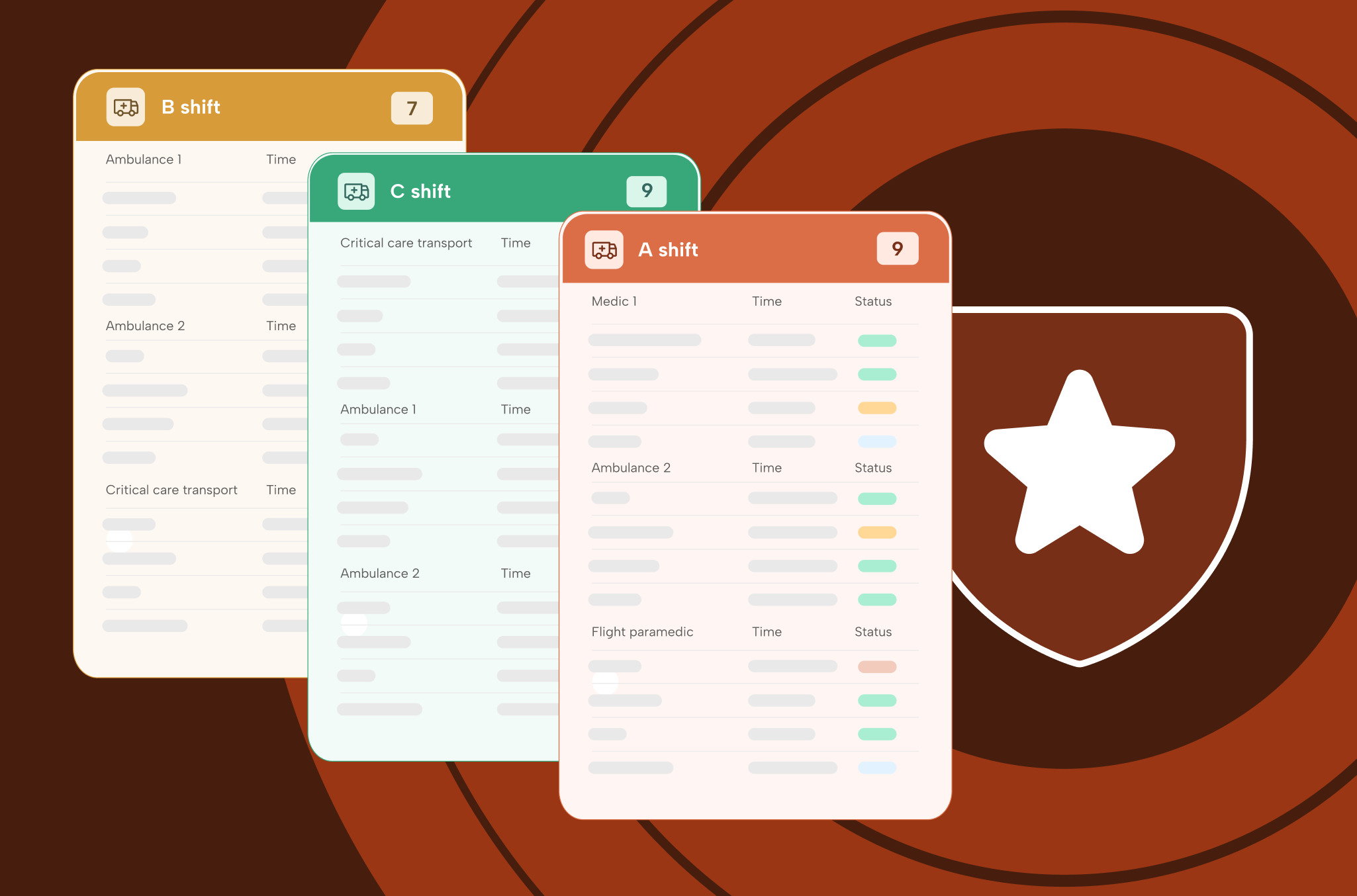
It’s the start of a new shift. An officer calls out sick. A dispatcher flags a gap in coverage. A supervisor starts making calls to fill the shift while keeping minimum staffing levels intact.
At the same time, certifications need to be verified, overtime thresholds are approaching, and union rules dictate who can take the open shift. Every decision carries weight not just for operations, but for safety, compliance, and public trust.
By mid-shift, the situation has stabilized. But the effort it took to get there pulled attention away from leadership, response readiness, and team support. Handling these scenarios every week for months on end has you and your teams exhausted.
Across public safety, scheduling pressures are shared, but the day-to-day realities vary depending on your agency:
- Law enforcement – Patrol coverage, court scheduling, specialized units, and unpredictable call volume
- Fire departments – 24-hour rotations, multi-station coverage, and role-based staffing requirements
- EMS agencies – Rapid response needs, fluctuating call volume, and credential-dependent staffing
Scheduling decisions directly impact response times, staff fatigue, compliance exposure, and operational readiness. Public safety scheduling has to operate at the speed of real-world events. Emergencies don’t wait, and neither can your staffing decisions. Yet many agencies still rely on manual processes like spreadsheets, whiteboards, or text chains, creating extended risk with every uncertainty:
One missed update can leave a shift uncovered.
One overlooked certification can delay a response.
One uneven rotation can lead to burnout and retention challenges.
This guide walks through what to look for in employee scheduling software for public safety, including the off-duty and extra-duty coordination that general workforce tools tend to skip. We’ll highlight the operational pressures your teams face and outline the capabilities that matter most, so you can evaluate solutions based on how your agency actually operates and keep your community safer.
Why employee scheduling is different in public safety
You operate at the pace of the unexpected. Call volume shifts without warning, emergencies escalate staffing needs instantly, and teams operate across rotating shifts, specialized roles, and multiple locations. Yet with all these moving constraints, you have fixed ones too with labor budgets, union agreements, fatigue rules, and compliance regulations.
Coverage gaps hit immediately once they open. Response times can slow, the right expertise may not be available when it’s needed most, and teams are forced to operate under increased strain. Over time, those moments affect operational performance, employee fatigue, and public trust.
Each role across your agency experiences these pressures differently:
- Command staff – Maintain minimum staffing levels, control labor costs, and stay compliant and audit-ready.
- Supervisors and schedulers – Build schedules, fill last-minute callouts, and balance staffing with certifications, seniority rules, and availability.
- Operations and administrative leaders – Need visibility into staffing patterns, overtime usage, and resource allocation across shifts and locations.
- IT teams – Support scheduling systems and reporting, often managing disconnected tools that limit visibility.
- Frontline personnel – Want clear schedules, fair shift distribution, and flexibility in a demanding role.
Across each role and agency type, minimum staffing levels, rest periods, and role-based qualifications all shape how public safety schedules are built and adjusted. And how quickly they can change.
In the sections ahead, we’ll look at how employee scheduling plays out across law enforcement, fire, EMS, and corrections environments and which capabilities matter most for each one.
Core capabilities every public safety scheduling solution should have
While your rotations may be set, your daily shift coverage is never static. Callouts, emergencies, skill requirements, and unexpected events constantly reshape staffing needs. When you’re dealing with manual scheduling, your teams spend valuable time reacting to problems instead of staying ahead of them.
Modern public safety scheduling requires capabilities designed for 24/7 operations, complex rules, and high-stakes decision-making. The right system helps you maintain coverage, stay compliant, and adapt quickly without creating additional administrative burden.
The following capabilities help public safety agencies keep schedules reliable while remaining flexible enough to respond to any situation:
- 24/7 rotational scheduling
- Automated shift coverage and callout response
- Compliance management
- Role- and certification-based scheduling
- Agency-wide visibility across units and locations
- Labor cost and overtime control
- Off-duty, extra-duty, and secondary employment management
24/7 rotational scheduling
Without stating the obvious, your shift patterns probably don’t follow a standard workday. Law enforcement teams may use 2-2-3 (or Panama) schedules or 8-hour patrol shifts, fire departments often run 24/48 or 48/96 schedules, and EMS crews may alternate between 12- and 24-hour coverage depending on call volume. Scheduling systems should have built-in support for these rotation patterns while making it easy to flex for vacations, training, or unexpected absences. Correctly managed rotations means you maintain consistent coverage without constantly rebuilding schedules or risking gaps between shifts.
Automated shift coverage and callout response
Callouts, sick time, and last-minute changes are constant across public safety. A patrol officer calls out before a night shift, a firefighter is unavailable for a scheduled rotation, or an EMT needs coverage during a peak call period. Solution capabilities should help fill these gaps with qualified personnel and real-time notifications, rather than relying on phone trees or manual outreach. Supervisors spend less time chasing coverage and can maintain minimum staffing levels without pulling attention away from operations.
During a major incident, the same automation should scale into an emergency recall: a structured, policy-driven callback process that identifies the most qualified available personnel and pushes mass notifications by text, email, and app, instead of a supervisor working down a phone tree by hand. Supervisors spend less time working the phones for coverage and more time maintaining minimum staffing levels.
Compliance and fatigue management
Union agreements, labor laws, fatigue rules, and internal policies all vary by agency and role. Firefighter work schedules may require minimum rest periods between 24-hour shifts, law enforcement agencies must track overtime thresholds and court appearances, and corrections teams often follow strict staffing ratios. Built-in guardrails should flag potential violations as schedules are created and monitored as changes occur. This helps agencies stay compliant, reduce risk, and protect both their staff and the communities they serve.
Role-, rank-, and certification-based scheduling
Not every employee can fill every role. In public safety, assigning the wrong person can create serious operational risk. A fire apparatus may require a certified driver and officer in charge, an EMS unit may need a paramedic and EMT combination, and certain law enforcement assignments require specific training or credentials. Scheduling systems should automatically match shifts with the correct qualifications, certifications, and ranks.
The right personnel assigned to the right positions, every time, supports both safety and operational effectiveness.
Agency-wide visibility across units and locations
Agency leaders need visibility beyond a single shift, station, or facility in isolation. A comprehensive, real-time view of staffing levels, overtime, and coverage across the entire agency provides clarity at any level. This makes it easier to identify gaps, spot trends, and maintain consistency in how schedules are built and managed. Without that visibility, issues like uneven staffing or rising overtime costs can go unnoticed until they become bigger problems.
Labor cost and overtime control
Scheduling decisions directly impact both budgets and morale, especially when overtime, extra duty, and emergency coverage can quickly drive up costs or fall disproportionately on the same employees. For example, unplanned overtime in a corrections facility or extended shifts during a major incident can strain budgets if not tracked closely. Systems should provide real-time visibility into labor costs, overtime usage, and staffing levels so leaders can make informed decisions before costs escalate.
That visibility should extend to fairness. Overtime and shift-bid decisions built on a documented rules engine (seniority, reverse seniority, or last-offered order) create a defensible audit trail for every offer and assignment, which cuts down on grievances and favoritism disputes before they start. By managing labor proactively, you can keep your agency ready without crashing your budget.
Off-duty, extra-duty, and secondary employment management
On-duty scheduling only covers part of the picture in law enforcement and fire. Off-duty details, special-event security, and extra-duty assignments generate a steady stream of secondary employment requests. If that work is tracked separately from your core schedule, it becomes its own administrative job: tracking down sign-ups, checking for fatigue conflicts against the regular rotation, and reconciling invoices by hand.
A public safety scheduling platform should let you evaluate off-duty and extra-duty capabilities the same way you evaluate on-duty scheduling. Look for a solution that can:
☑ Post and fill extra-duty and special-event jobs from the same system officers already use for their regular shifts
☑ Check extra-duty sign-ups against on-duty hours to flag fatigue risk and overtime thresholds before a shift is approved
☑ Automate billing and invoicing to the businesses or event organizers requesting coverage
☑ Export extra-duty and off-duty hours directly into payroll, so supervisors aren’t reconciling a second timesheet by hand
☑ Distribute jobs fairly using the same seniority or rotation rules that govern on-duty overtime
Agencies that keep off-duty payroll and extra-duty billing in a disconnected process, on paper, or in spreadsheets tend to lose the most time here, and it’s often the fastest win once a scheduling platform is in place.
How core capabilities apply to your public safety agency
Every public safety agency needs structure in how schedules are built, adjusted, and managed. What changes is how that structure supports your specific operating model.
Some agencies manage patrol coverage and detention staffing, while others coordinate multi-station fire response, credential-based EMS crews, or strict post coverage in corrections. The core capabilities remain the same, but what it looks like in your day-to-day operations depends on your team’s unique needs.
In the sections ahead, we’ll break down how these capabilities apply across:
- Law enforcement
- Sheriffs’ offices
- Fire departments
- EMS
- Corrections
Law enforcement
What makes staffing different here: Police departments have to balance patrol coverage, investigations, and specialized assignments while responding to unpredictable demands. One court appearance, late callout, or certification expiration can shift staffing fast, while supervisors still need to maintain minimum coverage, distribute overtime fairly, and adjust schedules in real time.
Capabilities that matter most:
While all public safety agencies benefit from strong scheduling systems, law enforcement teams depend heavily on:
- 24/7 rotational scheduling aligned to patrol coverage
- Fast, structured callout coverage
- Role and certification tracking
- Fair overtime and shift distribution
- Agency-wide visibility into staffing and labor usage
Look for software that:
☑ Maintains minimum staffing levels across patrol shifts and specialized assignments
☑ Automatically verifies that every officer has the right credentials for their assigned shift
☑ Quickly closes coverage gaps while keeping overtime costs in check and assignments fair
☑ Tracks court appearances, extra duty events, and overtime with better visibility
☑ Gives command staff a clearer view of staffing patterns and labor costs across the agency
Evaluating employee scheduling software vendors based on size and maturity
Basic scheduling stage
Who fits here: Smaller police departments or agencies still relying on paper schedules, whiteboards, spreadsheets, text messages, or disconnected systems to manage patrol coverage and last-minute changes.
At this stage, scheduling is reactive. Supervisors spend hours rebuilding schedules, filling callouts, and keeping track of changes that are not captured in one system. Overtime, certifications, and fairness often depend on manual oversight, which makes it harder to maintain consistent coverage without extra administrative work.
What you’re doing
“We build the schedule in Excel or on paper.”
“We call or text officers when someone can’t make a shift.”
“Court schedules and special assignments live in separate places.”
| What you need | Why it matters | Risks to watch for |
| Shift templates or rotation scheduling | Creates more structure for recurring patrol schedules without rebuilding from scratch every cycle | Schedules still depend heavily on manual edits and supervisor memory |
| Mobile schedule access | Makes it easier for officers to see shifts, updates, and changes quickly | Missed updates, late acknowledgments, or confusion around who is actually working |
| Structured shift gap workflows | Reduces the time supervisors spend chasing down coverage when someone calls out | Coverage gaps stay open too long or rely on informal phone trees that compromise fairness |
| Basic role and qualification tracking | Ensures that the right person is in the right place at the right time — with the right credentials | Certification issues or assignment conflicts are caught only after the schedule changes |
| Payroll-ready reporting | Improves handoff between scheduling and payroll and reduces manual reconciliation | Disconnected systems for extra duty or court appearances that force manual payroll edits |
Intermediate scheduling stage
Who fits here: Growing law enforcement agencies using basic scheduling tools that no longer scale across patrol teams, specialized units, court demands, or multiple divisions.
Complexity increases at this stage. Patrol coverage has to be balanced against court appearances, training, leave, and special assignments. Overtime creeps up quietly, and fairness becomes harder to manage when shifts and extra duty are distributed manually. Leaders want better visibility without adding more administrative burden to supervisors.
What you’re doing
“Our system works well enough for the main schedule, but it breaks down when things start changing.”
“We’re trying to manage overtime and fairness better, but it’s hard to stay on top of it.”
“We can see who is scheduled, but not always how those decisions affect labor costs across the agency.”
| What you need | Why it matters | Risks to watch for |
| Automated shift notifications and coverage alerts | Fills open shifts faster by surfacing available and qualified officers | Open shifts linger too long or repeatedly create avoidable overtime |
| Role- and certification-based scheduling | Ensures specialized assignments are covered by the right personnel | Unqualified officers are considered for assignments or certification expirations are easy to miss |
| Overtime monitoring during scheduling | Helps supervisors see overtime exposure before they finalize changes | Labor costs rise without clear warning until after the fact |
| Fairness controls for overtime and shift opportunities | Supports more consistent distribution of high-demand or extra duty shifts | The same officers are repeatedly used while fairness concerns and morale issues grow |
| Agency-wide schedule visibility | Gives leadership better visibility into staffing patterns, overtime, and scheduling consistency across the agency | Each unit manages staffing differently, making oversight and standardization difficult |
Advanced scheduling stage
Who fits here: Mid-market and enterprise law enforcement agencies already using larger workforce or HCM platforms that feel complex, expensive, or disconnected from how patrol operations actually run.
Here, you’ve got plenty of capabilities, but the issue comes with usability, visibility, and alignment. Command staff want clearer insight into staffing and labor costs. Supervisors want tools that help them respond quickly without creating more steps. Finance and payroll teams want clean data, stronger reporting, and less manual cleanup after schedules change.
What you’re doing
“We have a system, but it still takes too much work to make the schedule usable.”
“It’s hard to adjust quickly when patrol, court, and special assignments are all changing at once.”
“We have data, but it’s not easy to turn it into better staffing decisions.”
| What you need | Why it matters | Risks to watch for |
| Connected scheduling and labor cost visibility | Aligns staffing decisions with payroll, overtime, and reporting data | Data discrepancies between scheduling, payroll, and labor reporting still create rework |
| Agency-wide visibility into staffing and overtime | Compares staffing efficiency, labor usage, and scheduling patterns across units or precincts | Leadership has limited strategic visibility into where labor pressure is building |
| Configurable compliance and work-rule controls | Supports agency-specific rules, union policies, and localized scheduling needs without manual oversight | Generic system rules create friction or fail to reflect how the agency actually operates |
| Extra duty and court-time visibility | Improves control over additional labor spend and helps leadership understand the full staffing picture | Court assignments, extra duty, and overtime are still tracked across disconnected processes |
| Seniority-based shift bidding | Runs transparent bid cycles for patrol shifts and special assignments according to seniority and union rules | Manual bid administration creates disputes and contract compliance risk |
| Simplified payroll and audit-ready workflows | Reduces administrative burden and strengthens accountability when schedules change | Change history, edits, or labor adjustments are hard to track when questions come up later |
Sheriffs’ offices
What makes staffing different here:
Sheriffs’ offices have to schedule for two environments at once: patrol in the field and detention inside the jail. That means balancing 24/7 deputy coverage with fixed jail posts, courthouse security, inmate transport logistics, and certification requirements. When schedules are managed manually, it’s easier for coverage gaps, compliance issues, and overtime spikes to slip through.
Capabilities that matter most:
- 24/7 rotational scheduling that supports both patrol and detention coverage
- Automated coverage alerts to quickly fill open shifts with qualified deputies
- Certification tracking tied directly to scheduling decisions
- Real-time visibility into overtime, labor costs, and staffing levels
- Fair scheduling practices aligned with seniority and union rules
- Coordinated scheduling for court appearances, courthouse security, and inmate transport
Look for software that:
☑ Automates complex rotations like 12-hour Pitman schedules across patrol and jail staff
☑ Instantly notifies qualified deputies to fill vacancies or extra duty assignments
☑ Flags certification expirations before they create scheduling conflicts or liability risks
☑ Provides a single view of staffing across patrol, detention, and courthouse assignments
☑ Tracks court appearances, transport assignments, and extra duty alongside the regular schedule
Evaluating employee scheduling software vendors based on size and maturity
Basic scheduling stage
Who fits here: Smaller sheriffs’ offices or county agencies still relying on paper schedules, spreadsheets, whiteboards, or text chains to manage both patrol and jail staffing.
At this stage, scheduling is highly manual and reactive. Supervisors spend hours coordinating coverage across patrol and detention, often duplicating work between systems. Certification tracking and overtime monitoring are handled separately, increasing the risk of missed requirements, payroll errors, and compliance exposure
What you’re doing
“We build separate schedules for patrol and the jail.”
“We call or text deputies when we need to fill a shift.”
“We track certifications in spreadsheets or files.”
| What you need | Why it matters | Risks to watch for |
| Basic rotation templates or spreadsheet schedules | Provides minimal structure for recurring shifts but requires frequent manual updates across patrol and jail operations | Supervisors rebuild schedules weekly and rely on memory to manage coverage across different teams |
| Phone or text callouts | Allows shifts to be filled when vacancies occur, but depends heavily on time-consuming outreach | Open shifts remain unfilled for long periods or are filled inconsistently, leading to coverage gaps |
| Separate certification tracking | Maintains records for compliance and training requirements | Expired certifications are missed or discovered after scheduling, creating liability risk |
| Basic overtime tracking | Offers limited insight into labor usage | Overtime is only identified after payroll, making it difficult to control costs proactively |
Intermediate scheduling stage
Who fits here: Growing sheriff offices managing multiple facilities, increased staffing complexity, or higher call volume with tools that no longer scale.
When you’re at a large enough scale, coordination becomes more difficult as staffing needs grow. Patrol and detention schedules must stay aligned, while certifications, overtime, and fairness all require more oversight. Leaders need better visibility, but supervisors still spend significant time managing schedules manually.
What you’re doing
“We have a system, but it doesn’t handle both patrol and jail well.”
“Our supervisors are still spending hours every week adjusting schedules by hand.”
“We don’t always have a clear view of staffing across the agency.”
| What you need | Why it matters | Risks to watch for |
| Unified scheduling across patrol and detention | Improves coordination between field and facility staffing, reducing duplication and confusion | Separate systems or processes still create disconnects between patrol and jail coverage |
| Automated coverage alerts | Fills open shifts faster by notifying qualified deputies in real time | Coverage delays continue during nights, weekends, or emergencies |
| Certification-based scheduling | Ensures only qualified deputies are assigned to specific roles or posts | Unqualified staff are considered or scheduled due to lack of visibility into credentials |
| Overtime monitoring during scheduling | Helps identify labor cost risks before shifts are finalized | Overtime spikes continue without clear visibility or control |
Advanced scheduling stage
Who fits here: Mid-sized to large sheriffs’ offices that have adopted workforce systems but need better usability, visibility, and alignment across operations.
At this scale, the challenge shifts from capability to alignment — leadership needs clear insight into staffing, compliance, and budget across patrol, jail, and special assignments, while supervisors need tools that cut administrative burden. Open-shift reporting gives leadership the data to document persistent coverage gaps and justify future staffing or budget requests. Equally important, because sheriffs’ offices rarely get to choose the HR, payroll, and finance platforms the county runs on, scheduling needs to integrate with whatever’s already in place. If it doesn’t, every schedule change creates downstream reconciliation work.
What you’re doing
“We have tools, but they don’t reflect how our agency actually operates.”
“It’s still hard to adjust schedules quickly when things change.”
“We need better visibility into staffing and costs.”
| What you need | Why it matters | Risks to watch for |
| Agency-wide schedules | Provides real-time visibility into coverage, staffing levels, and labor usage across all divisions | Leadership lacks a clear view of where staffing gaps or inefficiencies exist |
| Built-in support for labor laws, union rules, and certification tracking | Reduces risk by verifying schedules meet all regulatory and skill requirements | Violations or expired certifications are identified after schedules are posted |
| Integrated labor cost and overtime reporting | Supports better budget planning and transparency for audits and public reporting | Difficulty tracking or justifying labor spend across departments |
| Fair scheduling and shift distribution tools | Yields consistent and transparent scheduling practices | Uneven shift distribution leads to burnout, complaints, or retention challenges |
| Court-time and extra duty visibility | Improves control over additional labor spend tied to courthouse assignments, transports, and off-duty work | Court and extra duty assignments are still tracked across disconnected systems |
Fire departments
What makes staffing different here: Fire departments manage long rotations like 24/48 or 48/96 schedules across multiple stations. Beyond a full crew, every shift needs the right mix of ranks and certifications to be emergency-ready. Callouts, training, vacation overlap, wildfires, and mutual aid requests can disrupt coverage fast, while manual scheduling makes it harder to catch understaffed apparatus, overtime spikes, and compliance issues.
Capabilities that matter most:
- Automated rotational scheduling for 24-hour and multi-day shifts
- Role-based scheduling with apparatus tracking
- Certification and credential tracking (EMT, hazmat, driver, officer)
- Real-time callout and coverage management
- Multi-station visibility into staffing and overtime
Look for software that:
☑ Automates complex fire rotations like 24/48 and 48/96 schedules
☑ Ensures each apparatus is staffed with the correct mix of roles and certifications
☑ Fills open shifts quickly with qualified personnel during callouts or emergencies
☑ Tracks certifications and flags expirations before they impact readiness and compliance
☑ Provides visibility across stations, shifts, and labor costs
Evaluating employee scheduling software vendors based on size and maturity
Basic scheduling stage
Who fits here: Smaller fire departments or volunteer/combination agencies relying on whiteboards, spreadsheets, or paper schedules to manage rotations.
Station captains or administrators spend hours updating rotations, filling last-minute gaps, and verifying staffing requirements. Certification tracking is often disconnected from scheduling, increasing the risk of assigning unqualified personnel. Visibility into overtime and staffing across stations is limited.
What you’re doing
“The schedule is already outdated by the time we post it.”
“We call or text firefighters to fill open shifts.”
“We manually track certifications and roles.”
| What you need | Why it matters | Risks to watch for |
| Whiteboard, spreadsheet, or paper rotations | Provides basic visibility into shifts but requires constant updates | Frequent errors, missed updates, or confusion across stations |
| Phone and text callouts | Allows coverage gaps to be filled when staff are available | Slow response times and inconsistent coverage during emergencies |
| Basic certification logs | Tracks firefighter qualifications | Expired or missing certifications discovered too late |
| Reactive overtime tracking | Captures labor usage after the fact | Overtime spikes without warning or control |
Intermediate scheduling stage
Who fits here: Growing fire departments managing multiple stations, increased staffing complexity, or higher call volumes with systems that no longer scale.
With growth, fire departments must balance multiple stations, vehicles, and staffing requirements simultaneously. Rotations are established, but real-time changes, like sick calls or training, create disruptions that are difficult to manage manually. Leaders need better visibility into staffing and labor costs, while maintaining consistent coverage and compliance.
What you’re doing
“Our rotation system works, but it’s hard to adjust when things change.”
“We’re trying to manage staffing across stations, but it’s not always clear who’s where and why.”
“Overtime keeps increasing, and we’re not sure why.”
| What you need | Why it matters | Risks to watch for |
| Automated rotation scheduling | Maintains consistent shift patterns with less manual effort | Manual overrides still required frequently |
| Credential-based staffing | Ensures each truck has the correct roles and certifications | Gaps in required roles or unbalanced crew assignments |
| Automated callout alerts | Fills open shifts faster with available personnel | Coverage delays during nights, weekends, or major incidents |
| Overtime monitoring | Provides visibility into labor costs during scheduling | Unexpected overtime spikes and budget pressure |
Advanced scheduling stage
Who fits here: Mid-sized to large fire departments using workforce systems but need better usability, visibility, and operational alignment.
At this stage, departments need systems built for the complexity of running multiple stations, crews, and apparatus at once. Leadership expects clear insight into staffing, readiness, and budget performance, while reducing administrative burden on command staff. Scheduling should support fast decision-making without sacrificing compliance or coverage.
What you’re doing
“We have a system, but it’s hard to adapt it to how we actually staff our stations.”
“We still spend too much time adjusting schedules manually.”
“We need better insight into staffing and labor costs.”
| What you need | Why it matters | Risks to watch for |
| Station-wide dashboards | Provides visibility into staffing levels and coverage across all stations | Limited insight into staffing gaps or inefficiencies |
| Built-in support for compliance and certification tracking | Ensures all roles meet training and safety requirements | Violations or gaps identified after schedules are finalized |
| Integrated labor cost reporting | Aligns staffing decisions with budget and overtime data | Difficulty tracking or explaining labor costs |
| Advanced schedule and shift optimization | Improves crew balance and reduces burnout | Uneven workload distribution and retention challenges |
| Seniority-based shift bidding | Automates union-rule bid cycles and posts assignments transparently | Manual bid management creates disputes, errors, and contract compliance risk |
EMS
What makes staffing different here:
EMS scheduling depends on the right crew being ready at the right time. Each unit needs the proper mix of paramedics, EMTs, drivers, and accompanying credentials and equipment before it can respond. Call volume, hospital delays, peak hours, and major incidents shift that demand in real time. Manual scheduling makes it harder to manage fatigue, fill gaps quickly, and avoid credential mismatches that can affect response times and patient outcomes. Tying digital incident reporting forms into the same platform also reduces post-call paperwork and keeps documentation tied to the crew that actually responded.
Capabilities that matter most:
- Credential-based scheduling aligned to team requirements
- Real-time visibility into unit readiness and coverage
- Automated callout and coverage gap workflows
- Mobile-first communication for rapid updates
- Historical call volume trend tracking to inform schedule planning
Look for software that:
☑ Staffs units based on qualifications, availability, and minimum staffing levels
☑ Provides real-time visibility into which units are fully staffed and ready to respond
☑ Enables rapid shift gap coverage through automated alerts and mobile response
☑ Tracks certifications and flags expirations before they impact operations
☑ Helps leadership monitor overtime, staffing trends, and demand patterns
Evaluating employee scheduling software vendors based on size and maturity
Basic scheduling stage
Who fits here: Smaller EMS agencies or teams relying on spreadsheets, whiteboards, or manual communication to manage staffing and unit coverage.
At this stage, scheduling is reactive and fragmented. Supervisors spend significant time verifying credentials, coordinating shift coverage, and managing last-minute changes. Because staffing and credential tracking are disconnected, there is a higher risk of deploying incomplete or unqualified crews. Visibility into staffing levels and overtime is limited, making it difficult to anticipate gaps during peak demand.
What you’re doing
“We build the schedule manually and adjust as things change.”
“We call or text staff when we need to fill shifts.”
“We track certifications separately from scheduling.”
| What you need | Why it matters | Risks to watch for |
| Spreadsheet or whiteboard schedules | Provides a basic structure for shifts but lacks real-time updates and coordination across units | Frequent errors, missed updates, and inconsistent communication across teams |
| Phone- and text-based callouts | Allows supervisors to fill open shifts when staff are available | Delayed responses and unfilled shifts during high-demand periods |
| Separate credential tracking systems | Maintains certification records for compliance purposes | Mismatched crews or expired certifications discovered after scheduling |
| Reactive overtime tracking | Captures labor usage after shifts are worked | Overtime increases without visibility or ability to control it proactively |
Intermediate scheduling stage
Who fits here: Growing EMS agencies managing more units, higher call volumes, and increased staffing complexity with systems that are no longer scalable.
As EMS teams grow, they’re balancing more moving parts. Coverage must adapt quickly to changing demand, but manual adjustments slow response times. Credential matching, shift coverage, and overtime management all require more coordination, and gaps in visibility make it harder to maintain consistent readiness.
What you’re doing
“We have a system, but it doesn’t always reflect what’s happening in real time.”
“We’re trying to manage staffing across multiple teams, but visibility is limited.”
“Overtime keeps increasing, and we’re not sure where it’s coming from.”
| What you need | Why it matters | Risks to watch for |
| Credential-based scheduling | Ensures each unit is staffed with the right mix of roles, drivers, and specialized certifications to be emergency-ready | Incomplete or mismatched crews assigned to units, impacting readiness |
| Automated shift coverage alerts | Fills open shifts faster by identifying and notifying available and qualified staff | Coverage gaps remain during nights, weekends, or emergencies |
| Real-time schedule visibility | Improves coordination across teams and shifts | Supervisors lack awareness of staffing gaps until they become urgent |
| Overtime monitoring and fair distribution | Helps identify labor cost risks and spread overtime equitably across the crew | Unexpected overtime spikes and budget pressure |
Advanced scheduling stage
Who fits here: Larger EMS agencies or regional systems that need better real-time alignment with call volume and operations.
At this stage, EMS agencies need systems that align with real-world operations. Scheduling needs the flexibility to quickly fill gaps as call volumes change, without compromising compliance or crew readiness. Leadership expects visibility into staffing trends and labor costs, while supervisors need tools that support fast decision-making without adding administrative burden. Open-shift reporting also helps leadership document recurring coverage gaps with the data needed to justify future staffing requests.
What you’re doing
“We have tools, but they don’t adapt to real-time call volumes.”
“It’s still difficult to adjust staffing quickly across all teams.”
“We need better insight into performance, staffing, and costs.”
| What you need | Why it matters | Risks to watch for |
| Real-time staffing visibility | Provides insight into unit readiness, staffing levels, and coverage across the system | Limited insight into where staffing gaps or inefficiencies are occurring |
| Built-in support for compliance and credential tracking | Ensures all crews meet certification requirements before deployment | Certification issues discovered after schedules are finalized |
| Integrated labor cost and overtime reporting | Aligns staffing decisions with budget performance to help manage labor costs | Difficulty tracking or explaining labor costs across the organization |
| Configurable post coverage and staffing rules | Lets agencies configure post coverage, shift rules, and staffing minimums to match how their crews actually operate | Rigid systems that can’t be configured to each agency’s posts, shift rules, or staffing minimums |
Corrections
What makes staffing different here:
Corrections scheduling has one non-negotiable rule: every post must be staffed, 24/7. With fixed ratios, defined posts, union rules, seniority, overtime policies, and fatigue concerns, even one absence can create a serious coverage gap. Manual scheduling makes those gaps harder to manage, increasing the risk of understaffing, safety issues, compliance problems, and overtime costs.
Capabilities that matter most:
- Post-based scheduling aligned to fixed staffing requirements
- Automated coverage and mandatory overtime workflows
- Real-time visibility into staffing levels across all units
- Overtime tracking and cost control
- Compliance with union rules, staffing ratios, and fatigue policies
Look for software that:
☑ Ensures every post is filled according to minimum staffing ratios
☑ Manages rule-based overtime assignments to maintain scheduling fairness and contract compliance
☑ Provides real-time visibility into staffing gaps across all units
☑ Tracks overtime and labor costs with full transparency
☑ Supports union rules, seniority, and fair distribution of shifts
Evaluating employee scheduling software vendors based on size and maturity
Basic scheduling stage
Who fits here: Smaller correctional facilities or departments relying on paper schedules, spreadsheets, or manual processes to manage post coverage.
Manual processes can no longer keep up with the demands of 24/7 post coverage at this stage. Supervisors spend hours ensuring posts are covered, often making last-minute calls to fill gaps. Overtime is frequently used to maintain coverage, but without clear visibility, costs rise as quickly as burnout does. Because processes are manual, tracking compliance with staffing ratios and labor rules becomes difficult, increasing operational and legal risk.
What you’re doing
“We build schedules manually for each unit.”
“We call staff in when someone doesn’t show up.”
“We track overtime after the fact.”
| What you need | Why it matters | Risks to watch for |
| Paper or spreadsheet post assignments | Provides basic structure for assigning staff to required posts | Frequent understaffing or confusion about coverage across units |
| Phone-based callouts | Allows supervisors to fill gaps as they arise | Delayed responses and reliance on mandatory overtime |
| Reactive overtime tracking | Captures labor costs after shifts are worked | Overtime costs escalate without warning |
| Paper or spreadsheet tracking | Maintains basic records for staffing and schedules | Errors, duplication, and lack of real-time visibility |
Intermediate scheduling stage
Who fits here: Growing correctional facilities managing more units, staff, and complexity with features that no longer scale effectively.
At this stage, facilities must manage more posts and more staff while maintaining strict coverage requirements. Manual processes begin to break down under the pressure of increased complexity. Supervisors need better visibility into staffing levels and overtime while ensuring compliance with policies and union rules.
What you’re doing
“We have a system, but it doesn’t help us manage all our posts.”
“We’re trying to control overtime, but it keeps increasing.”
“It’s hard to see where we have gaps until it’s urgent.”
| What you need | Why it matters | Risks to watch for |
| Automated post scheduling | Ensures required posts are filled consistently across shifts | Gaps still occur due to lack of real-time updates |
| Overtime monitoring during scheduling | Helps identify cost risks before shifts are finalized | Unexpected overtime spikes and budget strain |
| Centralized scheduling system | Improves coordination across units and shifts | Inconsistent practices across teams |
| Basic compliance tracking | Supports adherence to staffing ratios and rules | Violations identified after schedules are posted |
Advanced scheduling stage
Who fits here: Larger correctional facilities or systems using workforce tools but needing better alignment with operational demands and compliance requirements.
At this stage, facilities need systems that fully support operational realities. Scheduling must ensure every post is covered while balancing overtime, fairness, and compliance. Leadership requires clear visibility into staffing levels and labor costs, while supervisors need features that simplify decision-making without adding administrative burden.
What you’re doing
“We have tools, but they don’t reflect how our facility actually operates.”
“It’s still difficult to manage overtime and staffing fairly.”
“We need better visibility into staffing and compliance.”
| What you need | Why it matters | Risks to watch for |
| Facility-wide staffing dashboards | Provides real-time visibility into coverage across all posts and units | Limited insight into where staffing gaps or inefficiencies exist |
| Built-in support for compliance and rule enforcement | Ensures adherence to staffing ratios, union rules, and policies | Violations discovered after schedules are finalized |
| Integrated labor cost and overtime reporting | Aligns staffing decisions with budget to help manage labor costs | Difficulty tracking or controlling labor costs |
| Fair distribution and transparent overtime workflows | Improves morale and ensures consistent assignment of shifts | Burnout, complaints, and retention issues due to uneven workload |
| Seniority-based shift bidding | Automates contractual bid cycles and posts assignments transparently according to seniority and union rules | Manual bid management creates disputes, grievances, and compliance risk |
Questions to ask before you buy
Once you start evaluating employee scheduling software, the goal is to confirm the system can handle how your agency actually operates. A scheduling solution should support real staffing decisions, not force supervisors to work around the system when conditions change in the field, on a unit, or inside a facility.
Begin with foundational questions that test how scheduling works day to day. Then layer in questions specific to your public safety environment. Different agencies face different coverage pressures, compliance rules, and staffing models, so the right system should account for those differences.
Use these questions to pressure-test vendors and uncover whether their solution truly supports the realities of your workforce.
Bringing up real scheduling scenarios from your agency, like a last-minute callout, a certification conflict, or a staffing shortage, will quickly reveal which systems will actually help your team and which will still leave you doing manual work.
| Agency type | Questions to ask |
|---|---|
| Law enforcement |
|
| Sheriffs’ offices |
|
| Fire departments |
|
| EMS |
|
| Corrections |
|
ROI and total cost of ownership
If you’ve made it this far, you’re not evaluating employee scheduling software out of curiosity. You’re trying to solve a real operational strain: the cost of the status quo is showing up in overtime, staffing gaps, compliance risk, and workforce burnout.
Your agency is under constant pressure to maintain coverage without overspending. That means balancing minimum staffing requirements, filling critical coverage gaps on the fly, and managing labor costs in environments where even small inefficiencies add up quickly.
The exact return on investment depends on your type of agency and the challenges you face. Some environments feel the impact most through overtime and staffing shortages, while others see it in compliance exposure, administrative burden, or employee retention challenges.
The sections below break down the scheduling business case for each public safety environment, showing how operational improvements translate into measurable impact.
(Statistics sourced from public agency reports, workforce studies, and public safety research organizations)
Law enforcement ROI
- Overtime is one of the largest cost drivers in policing. The City of Houston reported police and fire overtime exceeding budget by more than $71 million (113%) in a single fiscal year, largely due to staffing gaps and reactive scheduling.
- Staffing shortages significantly increase overtime reliance. In Austin, over 95% of police officers worked overtime in a single year, highlighting how coverage gaps translate directly into labor costs.
- Court time, extra duty, and last-minute callouts create hidden labor costs when they are not tracked or managed proactively.
- Supervisors often spend 6–10+ hours per week managing schedules, filling shifts, and coordinating coverage, time pulled away from operations and leadership responsibilities.
- Uneven shift distribution and mandatory overtime contribute to burnout and retention challenges, increasing long-term staffing costs.
Sheriffs’ offices ROI
- Sheriffs’ offices must fund both patrol operations and detention staffing, effectively managing two labor-intensive environments within one budget.
- Jail staffing requirements are fixed and non-negotiable, meaning any absence immediately drives up overtime or mandatory coverage costs.
- Overtime in correctional environments can escalate quickly. For example, Connecticut’s Department of Correction has reported hundreds of millions in overtime costs annually, driven by staffing shortages and mandatory overtime.
- Managing patrol, jail, and courthouse staffing in separate systems creates inefficiencies and increases administrative workload.
- Lack of visibility across the agency leads to inconsistent scheduling practices and missed opportunities to control labor costs.
Fire department ROI
- Fire departments rely on long shifts (24-hour rotations), which increases fatigue risk and amplifies the cost of overtime when coverage gaps occur. Overtime often climbs during staffing shortages, large-scale incidents, and mutual aid situations, when agencies struggle to fill gaps without compromising emergency readiness.
- Ensuring every apparatus is staffed with the correct mix of roles (officer, driver, firefighter/EMT) is critical; imbalances can reduce operational effectiveness.
- Administrative time spent managing rotations, filling shift gaps, and tracking certifications adds up quickly across multiple stations.
- According to the U.S. Fire Administration, workforce shortages and increasing call volume continue to put pressure on staffing and budgets across fire departments.
EMS ROI
- Maintaining emergency readiness is critical, but manual processes can’t keep up with the chaos of last-minute callouts. Every minute spent trying to fill a gap in the roster is a minute that can impact response times and patient outcomes.
- Credential mismatches (e.g., missing a paramedic on a unit) can take units out of service, reducing coverage and increasing risk.
- Overtime increases when agencies rely on reactive scheduling to fill last-minute gaps.
- EMS agencies are experiencing significant workforce shortages, with paramedic and EMT turnover rates ranging from 20% to 30% annually, contributing to longer response times and coverage challenges.
Corrections ROI
- In many states, correctional overtime has reached critical levels, with some agencies reporting tens to hundreds of millions in annual overtime costs due to staffing shortages.
- High overtime levels are directly linked to burnout, safety concerns, and retention challenges among correctional officers.
- Manual scheduling increases the risk of understaffed units, compliance violations, and administrative inefficiencies.
- Turnover in corrections creates a compounding cost problem — vacancies increase overtime, which increases burnout, which drives further turnover.
Frequently asked questions
What is public safety scheduling software?
Public safety scheduling software helps law enforcement, fire, EMS, and corrections agencies build and manage 24/7 rotations, fill open shifts, track certifications, and control overtime, replacing paper schedules, whiteboards, and spreadsheets with an automated, mobile-accessible system.
How does public safety scheduling software handle off-duty and extra-duty assignments?
The strongest solutions manage off-duty and extra-duty work in the same platform as the regular schedule, so extra-duty sign-ups get checked against on-duty hours for fatigue and overtime risk, billing to the requesting business or event organizer is automated, and completed hours flow directly into payroll instead of a separate spreadsheet.
Can scheduling software manage an emergency recall or callback?
Yes. Instead of a supervisor working down a phone tree, a rules-based system can identify the most qualified available personnel based on seniority, certifications, and fatigue rules, then push a mass notification by text, email, and app in seconds.
How does scheduling software support Pitman, 24/48, or Panama rotations?
Public safety scheduling platforms build these rotation patterns in as templates: 12-hour Pitman schedules for patrol and jail staff, 24/48 or 48/96 shifts for fire crews, and 2-2-3 (Panama) rotations for law enforcement. That means agencies don’t have to manually rebuild the pattern every cycle.
What is the ROI of public safety scheduling software?
ROI shows up primarily in reduced overtime spend, fewer supervisor hours spent on manual schedule building and coverage calls, lower compliance risk from missed certifications or fatigue violations, and better retention from fairer, more transparent shift and overtime distribution.
Elevate your public safety agency with better scheduling
Imagine your agency at the start of a shift where coverage feels intentional. Every unit, post, or apparatus is staffed with the right mix of roles and certifications. There are no last-minute gaps, no scrambling to fill a callout, and no uncertainty about whether you’re meeting staffing requirements.
Your supervisors don’t waste extra hours making calls or reworking schedules. They can see coverage clearly, make adjustments quickly, and trust the system to handle the details. Your team knows when they’re working, understands how shifts are assigned, and feels confident that schedules are fair.
That level of control doesn’t happen by accident. You deserve a scheduling approach designed for the realities of public safety.
Your agency operates differently when schedules match your unique rotation patterns, support compliance with your union rules and labor laws, and give leadership full visibility across shifts, units, and locations. Coverage becomes more consistent. Overtime becomes more predictable. Decision making becomes faster and more informed.
Public safety will always be unpredictable.
Callouts. Emergency events. Staffing shortages. They’re part of the job. The difference is whether your scheduling process absorbs that pressure or amplifies it. That’s where TCP comes in with Aladtec. It’s built specifically for public safety, shaped around 24/7 rotations, certification tracking, and the realities of callouts, court appearances, and minimum staffing, so your scheduling process works the way your agency actually runs.
If you’re ready to move from the chaos of manual scheduling to confident, controlled coverage across every shift, this is the moment to take that step.
TCP Software’s employee scheduling and time and attendance solutions have the flexibility and scalability to suit your business and your employees, now and as you grow.
From TimeClock Plus, which automates even the most complex payroll calculations and leave management requests, to Humanity Schedule for dynamic employee scheduling that saves you time and money, we have everything you need to meet your organization’s needs, no matter how unique. Plus, with Aladtec, we offer 24/7 public safety scheduling solutions for your hometown heroes.
Ready to learn how TCP Software takes the pain out of employee scheduling and time tracking? Speak with an expert today.
What to read next
Explore all resources




 Link copied!


