
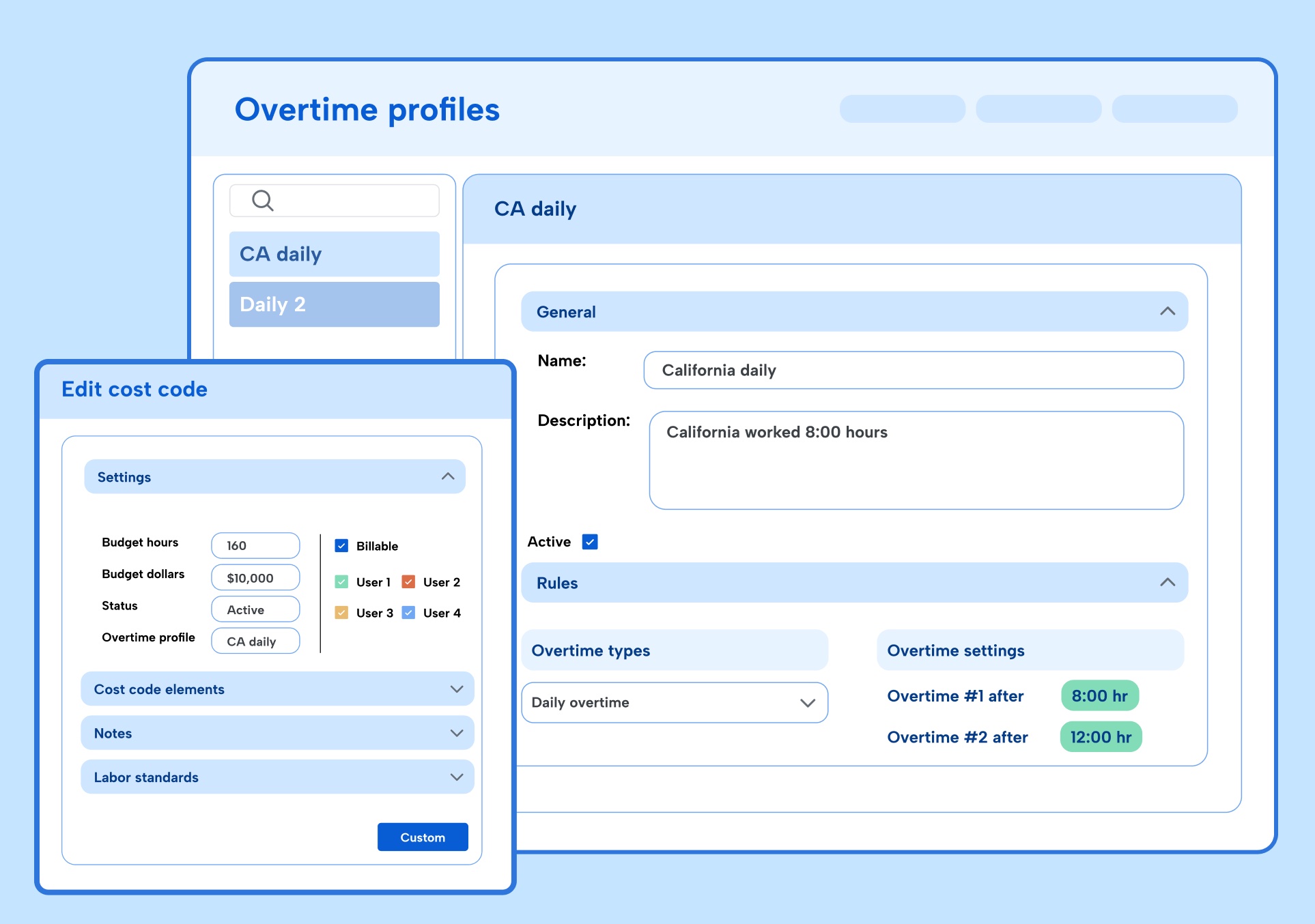
Overtime, like most time tracking, isn’t always straightforward. It gets complicated, messy, confusing, and even all three at the same time, especially when overtime feels like a never-ending list of exceptions.
Your organization doesn’t struggle with understanding overtime rules but keeping up with how work (and the overtime that follows) actually happens isn’t easy. Your system probably still applies overtime the same way:
One employee = one set of overtime rules.
If your employees do the same type of work, in the same place, all week? This works just fine. But that’s not how most teams operate anymore. Yet there are no overtime profiles, i.e. a subset of rules to follow for employees with overtime hours outside the normal parameters. Employees often:
- Work in different states throughout the week
- Switch between projects with different requirements
- Take on work under different contracts/agreements
When this happens, applying one rule across all employee time is impossible (and inaccurate). So why does overtime really mess up your time tracking strategy?
The challenge: Overtime is reactive, redundant, and risky
Take a field technician who works Monday-Wednesday in California, then Thursday-Friday in Colorado.
Each state calculates overtime differently, but if your system only supports one set of rules per employee, it can’t account for that split. The work falls to your payroll team, who has to:
- Pull the timecard manually
- Review each day’s logged hours
- Manually adjust the overtime calculation
- Double-check that everything adds up
Repeating this process every pay period for just one employee isn’t a good use of time for your payroll team. It’s inefficient and exhausting. If your organization has employees who move between locations, roles, or projects, you’re compounding the amount of overtime oversight needed… and making your payroll team’s lives much harder than they need to be.
Forget the inconvenience of it — reactive overtime management adds hours of extra work, increases the risk of costly errors, and widens the gap between overtime calculation and how the work really happens.
There’s a better way.
Introducing overtime profiles: The way to get ahead and stay ahead of overtime
Overtime profiles in TimeClock Plus are designed to solve your overtime problem.
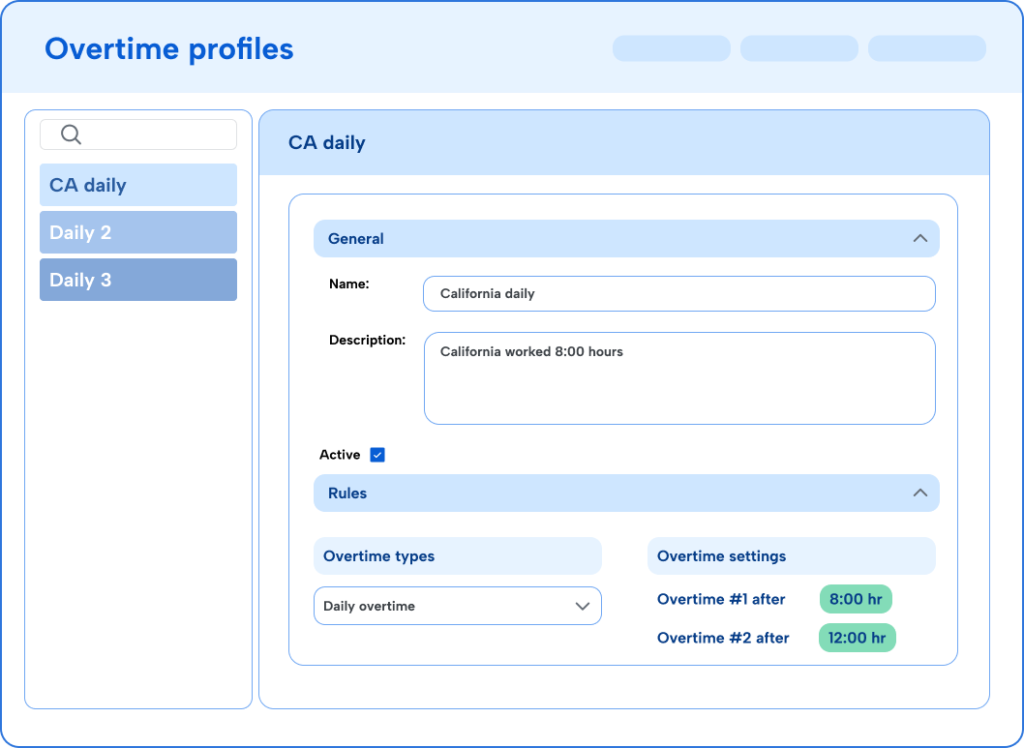
Instead of applying one rule across an entire employee’s timecard, overtime profiles allow you to:
Define multiple overtime rule sets
Assign those rules to specific types of work
Automatically apply the correct rules at the time segment level
This means overtime is calculated based on the work being done, not just who’s doing it.
How overtime profiles works
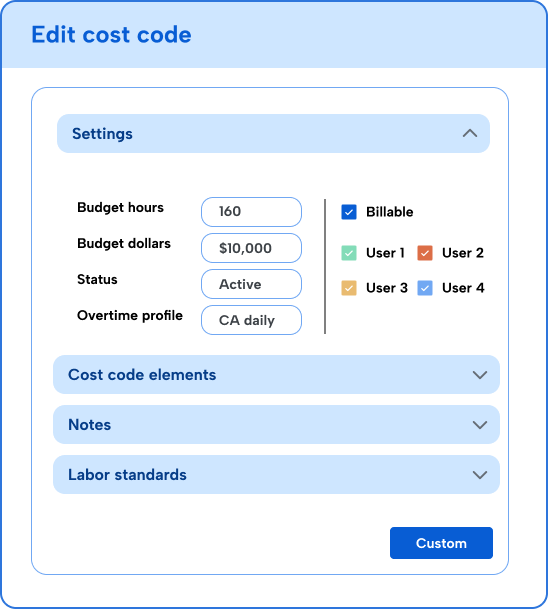
At a high level, overtime profiles are designed to be flexible but easy to manage: create reusable overtime rule sets (profiles), assign those profiles to cost codes, and track employee time using those cost codes.
When a cost code has an assigned profile, the system automatically applies those overtime rules, overriding employee-level rules for that segment.
Your calculations remain accurate across the full timecard without payroll having to second-guess.
Before and after: Managing overtime with overtime profiles
| Challenge | Without overtime profiles | With overtime profiles |
| Multi-state work | One rule applied across all time | Rules adjust automatically based on where work is performed |
| Different job types or contracts | Manual corrections required | Rules applied per work segment |
| Compliance risk | Higher risk of errors | More accurate, consistent calculations |
| Payroll processing | Time-consuming and manual | Overtime rules are applied automatically during time tracking |
Who overtime profiles is built for
Not every organization faces the same overtime challenges. If yours handles one or more of these workforce realities, overtime profiles were created with your teams in mind.
Multi-state workforces
Employees who cross state lines during the same workweek may be subject to different overtime laws. Overtime profiles ensure those rules are applied correctly, without manual intervention.
Public sector and union environments
Different contracts and agreements often require different overtime calculations. Applying the right rules automatically helps reduce compliance risk and the hassle your payroll teams face each pay period.
Field-based and mobile teams
When employees move between job sites, locations, or roles, overtime eligibility can change. Overtime profiles allow your organization to track and calculate overtime pay accurately based on each segment of work.
Project-based or cost code-driven work
When overtime requirements vary by project or job cost code, applying rules by segments keeps your calculations aligned with both business and regulatory requirements.
The ROI of overtime profiles for your organization
When overtime has to be fixed after the fact, it slows everything down.
Payroll teams spend more time reviewing and adjusting timecards, and your organization takes on more risk when calculations aren’t applied consistently. As work becomes more complex, those challenges only grow.
Overtime profiles help you:
- Reduce payroll errors and rework
- Improve labor compliance with complex regulations
- Save time during payroll with fewer manual timecard adjustments
As your organization grows across locations, roles, and regulatory environments, overtime profiles ensure you can scale your overtime management strategy too.
Looking ahead
Overtime isn’t getting simpler.
As your organization expands across locations, roles, and regulatory environments – and as those regulatory environments change – applying a single overtime rule per employee becomes increasingly limiting. Systems need to adapt to how work is performed, not the other way around.
Overtime profiles in Timeclock Plus allows organizations to apply different overtime rules to different segments of work within the same employee’s timecard, improving accuracy, efficiency, and compliance.
About TCP Software and TimeClock Plus
TCP Software provides flexible workforce management solutions that help your organization improve time tracking, simplify compliance, and reduce administrative burden.
With configurable functionality like overtime profiles, your organization can align time tracking with work as it really happens, for greater accuracy and efficiency at every step.
TCP Software’s employee scheduling, time, and attendance solutions are flexible and scalable to accommodate your organization and employees as you grow.
From TimeClock Plus, which automates even the most complex payroll calculations and leave management requests, to Humanity Schedule for dynamic employee scheduling that saves you time and money, we have everything you need to meet your organization’s needs, no matter how unique.
Plus, with Aladtec, we offer 24/7 public safety scheduling solutions for your hometown heroes.
Ready to learn how TCP Software takes the pain out of employee scheduling and time tracking? Speak with an expert today.
What to read next
Explore all resources





 Link copied!


