

Paid holidays are the days your organization pays employees for time off, usually tied to nationally recognized events, religious observances, or cultural celebrations. The concept is easy, but the devil’s in the details: which holidays employers actually have to observe, who qualifies for the pay, and how that pay gets calculated.
This guide breaks down paid holidays in the U.S. month by month, so HR, payroll, and operations teams can answer questions with confidence instead of guesswork.
If you need a quick reference, jump to the graphic below. Now, let’s start with the basics.
What are paid holidays?
Paid holidays are days when employees are given time off work with pay. These days are usually tied to nationally recognized events, religious observances, or cultural celebrations.
Private organizations get to decide which paid holidays to offer, if any — federal law doesn’t require it. According to the Fair Labor Standards Act (FLSA), paid holidays are established between employers and employees, so holiday pay varies from organization to organization.
How do paid holidays work?
While many employers offer paid holidays, eligibility and compensation often depend on an employee’s status.
- Full-time, nonexempt employees – Typically receive their standard wages on designated paid holidays, even if they don’t work that day.
- Part-time employees (such as those in retail or hospitality) – May not automatically receive holiday pay, though some organizations choose to prorate holiday benefits based on average hours worked or tenure.
- Employees in unions or those with collective bargaining agreements (CBAs) – Can spell out different rules for eligibility, pay rates, or alternative days off.
In industries like hospitality, emergency services, or healthcare, employees who work on a holiday may be eligible for holiday premium pay. Common forms include:
- Overtime pay for hours beyond the standard workweek
- Double-time pay for hours worked on the holiday itself
- Additional PTO banked for use later
These incentives help maintain coverage while acknowledging the added burden of holiday work.
Paid holidays in 2026
The calendar might look the same every year, but holiday dates and how they’re handled can change. Here’s the complete list of the 11 federal holidays in 2026 you need to know if you’re managing teams, HR, or payroll. Keep in mind, private organizations aren’t required to give time off for federal holidays but may choose to do so:
| Holiday | 2026 Date | Day of Week |
| New Year’s Day | January 1 | Thursday |
| Martin Luther King, Jr. Day | January 19 | Monday |
| Washington’s Birthday (Presidents’ Day) | February 16 | Monday |
| Memorial Day | May 25 | Monday |
| Juneteenth National Independence Day | June 19 | Friday |
| Independence Day | July 4 (observed Friday, July 3) | Saturday |
| Labor Day | September 7 | Monday |
| Columbus Day | October 12 | Monday |
| Veterans Day | November 11 | Wednesday |
| Thanksgiving Day | November 26 | Thursday |
| Christmas Day | December 25 | Friday |
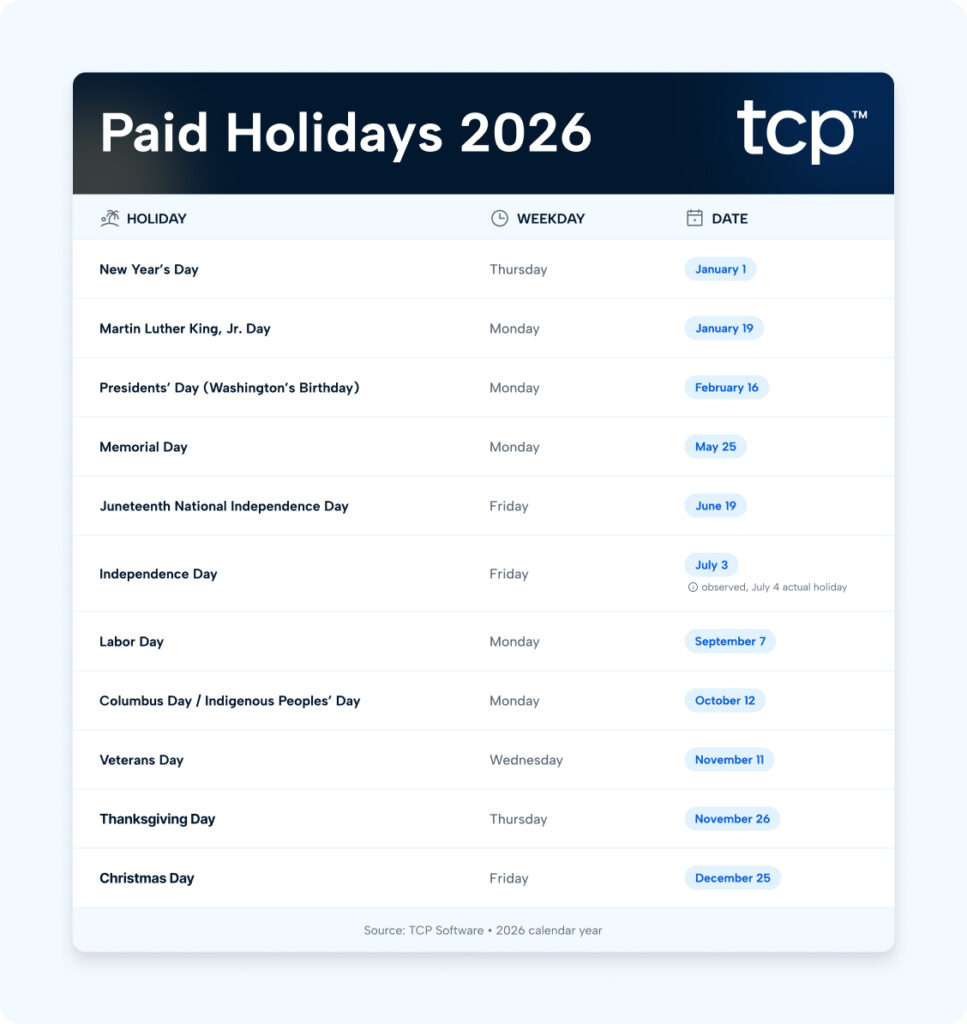
If you want a month-by-month breakdown of the key U.S. holidays in 2026, including federal and cultural holidays, and which are commonly paid, keep reading.
Paid holidays in January
Start the year strong by knowing what to expect for the first major holidays of the year.
Is New Year’s Day a paid holiday?
Yes, for most. New Year’s Day (January 1) is among the most commonly recognized paid holidays in the U.S., observed by nearly all federal, state, and private employers.
Is Martin Luther King, Jr. Day a paid holiday?
MLK Day (January 19 in 2026) is observed on the third Monday of January each year. It’s a paid federal holiday, meaning federal employees get the day off. Many private employers also observe it, but not all. It’s best to check your organization’s policy.
Paid holidays in February
February offers the last federal holiday for a three-month stretch, plus a few other cultural holidays.
Is National Freedom Day a paid holiday?
National Freedom Day celebrates the start of Black History Month on the anniversary of Abraham Lincoln’s signing of the 13th Amendment (which abolished slavery in the United States on February 1, 1865). However, it is recognized as a cultural holiday, not a paid one.
Is Valentine’s Day a paid holiday?
While it is one of the most notable holidays in the U.S., Valentine’s Day (February 14) is not a paid holiday.
Is Presidents’ Day a paid holiday?
Presidents’ Day (February 16 in 2026) is a federal holiday. It’s not universal, but many private employers recognize it, especially in government-adjacent or corporate roles.
Paid holidays in March
March doesn’t have any federal holidays, but that doesn’t mean your workplace won’t observe one.
Is Mardi Gras a paid holiday?
Mardi Gras is only recognized as a paid holiday in a handful of states, like those near the place of the holiday’s origin in Louisiana and Alabama, mostly in local government or tourism industries. It’s rarely offered in the private sector.
Is Ash Wednesday a paid holiday?
While it’s a significant day of observance for many Christian denominations, especially within Catholic and Anglican traditions, it’s not recognized as a federal holiday in the U.S. As a result, most public and private employers don’t offer paid time off for it.
Is St. Patrick’s Day a paid holiday?
St. Patrick’s Day is widely celebrated, but employers rarely offer it as a paid holiday.
Paid holidays in April
April brings a few holidays with cultural or religious significance, but few employers close their doors or offer time off. That’s because the U.S., by constitution, is technically not a religion-bound country. Certain regions or states may implement different religious holiday rules.
Is Good Friday a paid holiday?
Good Friday is not a federal holiday, but some states — including North Dakota and parts of Texas — observe it officially. Whether it’s paid depends on the employer.
Is Easter Monday a paid holiday?
In the U.S., Easter Monday is not typically a paid holiday, even though it’s observed in some other countries.
Paid holidays in May
May marks the unofficial start of summer — and a reliably observed holiday weekend.
Is Mother’s Day a paid holiday?
Mother’s Day is a Sunday celebration and is not considered a paid holiday by employers.
Is Memorial Day a paid holiday?
Yes, in most cases. Memorial Day (May 25 in 2026) is a federal holiday widely recognized as a paid day off in both the public and private sectors.
Paid holidays in June
June is a quieter month for nationally recognized paid holidays, but it often kicks off summer schedules, seasonal PTO requests, and company observances tied to school breaks or midyear resets.
Whether or not your organization closes for specific days, this month can still impact time-off planning and workforce availability, especially for teams juggling vacations or adjusting to new shift patterns.
Is Father’s Day a paid holiday?
No, Father’s Day — like Mother’s Day — is a cultural holiday and not typically a paid day off.
Is Juneteenth/Emancipation Day a paid holiday?
Juneteenth (June 19) became a federal holiday in 2021, so federal employees get the day off — and a growing number of private employers now offer it too.
As of 2026, over half of U.S. states have designated Juneteenth as an official paid holiday for state workers. The list is evolving, so it’s best to consult your state’s HR portal for updates.
Paid holidays in July
Fireworks, parades, and paid time off? July is a cornerstone of American holiday culture.
Is Fourth of July/Independence Day a paid holiday?
Yes. Independence Day (July 4) is a federal holiday and is nearly universally recognized as a paid day off. In 2026, July 4 falls on a Saturday, so many organizations will observe it on Friday, July 3 instead.
Paid holidays in August
August is one of the few months with no major national holidays.
However, it is back-to-school season in the United States and nearing the end of summer vacation season. Some employers may offer floating holidays in August, especially in industries with heavy workloads during other seasons.
Paid holidays in September
As fall begins, September offers one of the most reliable paid holidays of the year.
Is Labor Day a paid holiday?
Yes. Labor Day (September 7 in 2026) is a federal holiday and is widely offered as a paid day off. It started during the Industrial Revolution as part of a movement by labor unions to celebrate the American worker and advocate for more time off.
Paid holidays in October
October can be a mixed bag. Some states recognize the month’s main holiday, Columbus Day, while others don’t.
Is Indigenous Peoples’ Day/Columbus Day a paid holiday?
Columbus Day (October 12 in 2026) is a federal holiday, but recognition varies. Some employers offer it as a paid holiday, while others replace it with Indigenous Peoples’ Day or skip it altogether.
Is Halloween a paid holiday?
Halloween is not a paid holiday, but may be celebrated with shorter hours or office events.
Paid holidays in November
With three key dates in one month, November is one of the busiest paid holiday months.
Is Veterans Day a paid holiday?
Veterans Day (November 11) is a federal holiday. It’s a paid day off for government employees and some private employers, especially in the defense and public service sectors. Some may offer Veterans Day off for veteran staff, or for all employees in respect of the holiday.
Is Thanksgiving a paid holiday?
Yes. Thanksgiving Day (November 26 in 2026) is a federal holiday and one of the most widely observed paid holidays.
Is the Friday after Thanksgiving a paid holiday?
It depends. Most employers offer Black Friday (November 27) either as a paid holiday or allow it as a floating holiday. Others expect regular attendance.
Paid holidays in December
December wraps up the year with several culturally significant days that may or may not be paid.
Is Christmas Eve a paid holiday?
Not officially. However, most employers recognize the need for travel and the general lack of availability during this time. Employers may offer a half-day or full day off on December 24, especially for salaried employees or those working in non-critical sectors, but it’s not a federal holiday.
Is Christmas Day a paid holiday?
Yes. December 25 is a federal holiday and almost always a paid day off. In 2026, Christmas falls on a Friday, so it’s observed on its actual date. In years when it lands on a Saturday or Sunday, it may be observed on the preceding Friday and/or following Monday instead.
Is New Year’s Eve a paid holiday?
Not usually. December 31 is not a federal holiday, though some organizations may offer early release.
Benefits of offering paid holidays
It’s not always easy to balance operational goals with time-off policies. But offering paid holidays can be more than just a kind gesture if you play your cards right.
Here’s why offering paid holidays matters:
Paid holidays are a retention play
When employees have the time and space to disconnect, they return more focused. Paid holidays give teams the chance to rest without falling behind or missing out, which helps build loyalty, motivation, and, most importantly, improve scheduling and retention.
When you demonstrate your organization respects boundaries between work and personal life — like not making someone come into work the day after Thanksgiving — it’s something employees don’t forget.
Paid holidays keep your workforce healthy
Burnout doesn’t always show up overnight. It builds over time when people don’t get the recovery they need. While PTO helps, employees often prefer holidays when everyone’s off simultaneously. There’s no catching up to do when they return, making it easier to truly unplug.
This kind of rest reduces absenteeism, supports mental health, and can help with employee satisfaction.
A 2018 APA survey found that taking time off helps the majority of U.S. workers recover from stress and experience positive effects that improve their well-being and job performance. Of those surveyed, 68% reported a more positive mood and 57% felt less stressed after returning from vacation.
Paid holidays improve your employer brand
Your paid holiday policy can say a lot about how you treat people. When candidates or employees talk about your culture, time off is one of the first things that comes up.
A clear, competitive policy sends the message that you care about more than just output, which makes your organization stand out. In business, signing deals or getting new customers can come down to, “How does this organization treat their people, because that’s how they’ll treat me.”
Paid holidays give you a hiring advantage
When skilled candidates are choosing between offers, benefits can tip the scale. Salaries can be adjusted, but a strong, built-in paid holiday policy can be the difference between someone accepting your offer and going elsewhere.
And for existing employees, knowing those holidays are protected in your employee leave management strategy helps them stay longer and feel more committed to your team.
Tip: There’s no one-size-fits-all model. Build your holiday policy based on your team’s needs, your operating schedule, and the realities of your industry. Not everyone can offer every holiday off, but an intentional policy always beats no policy.
Quick questions about paid holidays
How many paid holidays do employers typically offer?
There’s no legal minimum or maximum. Most private employers that offer paid holidays cover the six major ones — New Year’s Day, Memorial Day, Independence Day, Labor Day, Thanksgiving, and Christmas — and add several more from the federal list depending on industry and location.
Does state law require holiday pay?
Federal law leaves holiday pay up to the employer, but a handful of states add their own rules:
| State | What the law requires |
| Massachusetts | Blue laws still require some retailers to pay time-and-a-half on select holidays. |
| Rhode Island | Premium pay is required for many employees who work on a holiday, regardless of industry. |
| Most other states | No state law mandates holiday pay — it’s an employer choice, same as under federal law. |
It’s worth checking your state labor department before finalizing a policy, especially if you operate across state lines.
Use a leave management system to automate holiday pay
If you’re an HR, payroll, or management professional, you’ve got a lot of things to keep in mind in your day-to-day. Adding all these holidays to the mix and trying to keep track of them manually can lead to errors, inconsistent practices, and payroll headaches.
With leave management software, as part of a broader time and attendance solution, you can:
- Automatically apply paid holiday rules based on factors like seniority, role, and compliance
- Create more accessibility into employee accrual and leave, including paid holidays, with 24/7 self-service access
- Forecast coverage gaps and scheduling needs in advance
- Enable time-and-a-half or double-time pay for hourly workers who choose to work on holidays
- Pre-load holiday schedules across departments and locations
- Prevent costly compliance issues with collective bargaining agreements (CBAs) and/or internal policies
TCP believes organizations shouldn’t have to choose between meeting their goals and keeping their employees happy, regardless of the complexity of the company’s operational needs. Backed by our time and attendance solution, you can keep your bottom line in check, all while improving your and your employees’ experience with paid holiday management.
TCP Software’s employee scheduling, time, and attendance solutions are flexible and scalable to accommodate your organization and employees as you grow.
From TimeClock Plus, which automates even the most complex payroll calculations and leave management requests, to Humanity Schedule for dynamic employee scheduling that saves you time and money, we have everything you need to meet your organization’s needs, no matter how unique.
Plus, with Aladtec, we offer 24/7 public safety scheduling solutions for your hometown heroes.
Ready to learn how TCP Software takes the pain out of employee scheduling and time tracking? Speak with an expert today.
What to read next
Explore all resources





 Link copied!


